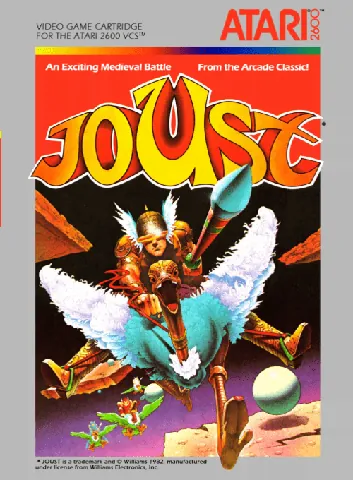
You mount an ostrich, take to the air, and try to be higher than your opponent on his vulture at the moment of collision. Welcome to Joust — a game so bizarre and yet so perfectly balanced that it became an immortal arcade legend.
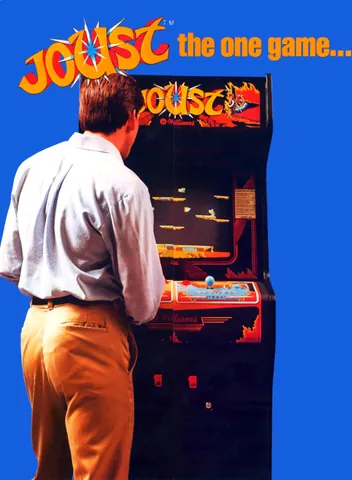
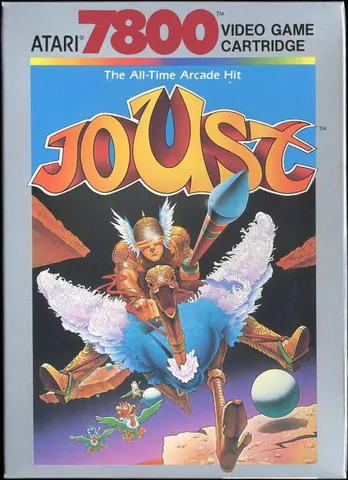
The original arcade machine was created by Williams Electronics and released in 1982. Joust became famous as one of the first games with a full-fledged cooperative mode for two players, where cooperation and competition merged into one. The version for the Atari 2600 and the later release for the Atari 7800 brought this idea into homes, with the 7800 port offering something closer to the arcade graphics.
The principle is easy to understand, hard to master. You flap your flying ostrich's wings with a button and move across platforms in an arena. When you crash into an enemy, whoever is higher at the moment of collision wins. The loser turns into an egg, which you must collect before a new, stronger rider hatches from it. In between there is lurking lava, a pterodactyl, and in two-player mode the constant dilemma of whether to cooperate or steal points from your rival. The wing-flapping controls have an unmistakable rhythm that you have to learn to feel.
Culturally, Joust is one of the pillars of the golden age of arcades, and its cooperative two-player mode foreshadowed many later titles. It became such an icon that it received a sequel and countless re-releases, and to this day players remember it as a textbook example of a simple but inexhaustible game mechanic.
Thanks to emulation and Atari compilations, you can play Joust on handhelds and in the browser, and it still shines best with two players. It is one of those titles where friendships and quarrels are born during a single collision in the air.
Why play: A brilliantly balanced duel on flying ostriches that never ends with two players. A pillar of the golden age of arcades.
Game 23 of 69 for Atari 2600
The same title elsewhere (4)
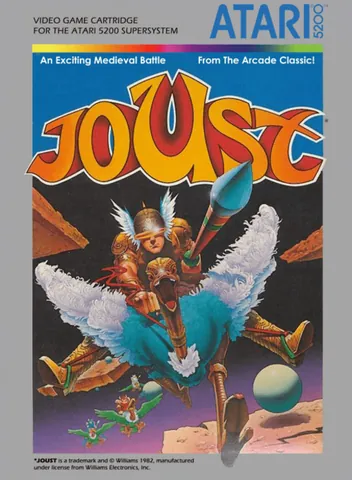
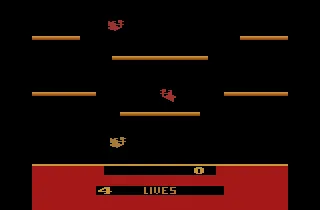
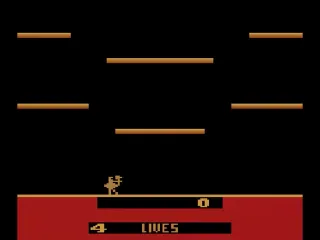
The arcade machine offered smooth animation of the flying ostriches and buzzards along with a vivid color palette that home consoles of the era tried to match with mixed success. The weaker Atari 2600 hardware forced blockier graphics, a more limited color range and simpler sound, which slowed the game down and drained some atmosphere compared to the arcade cabinet. The Atari 5200 ran on a more powerful chipset than the 2600, so its version offered smoother flight and more colorful surroundings closer to the arcade original. Anyone wanting Joust at its best should go for the arcade version, while those after a solid early-1980s home experience will prefer the Atari 5200 over the older 2600.