The Empire Strikes Back (1985, Atari)
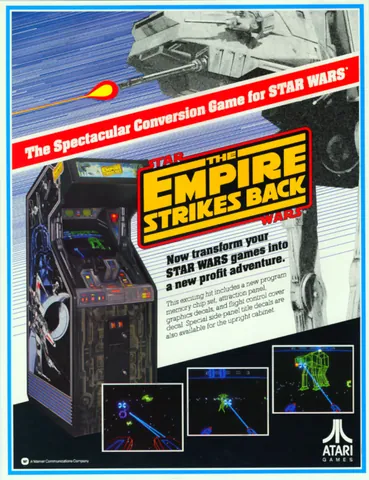
After the triumph of the Star Wars arcade game came the logical next step in 1985: The Empire Strikes Back, which carried Atari’s vector action to the icy world of Hoth. For fans of the second film, which many consider the peak of the whole saga, it was a chance to relive its most famous moments right at the joystick.
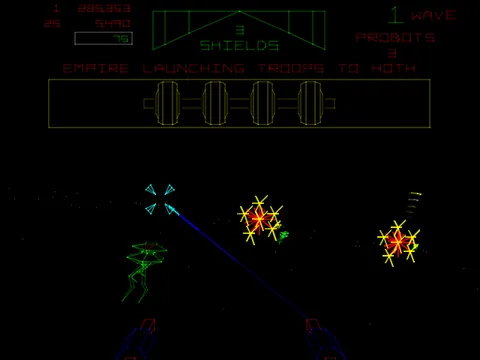
The game builds on the gameplay of its predecessor — again it is a rail shooter from the cockpit view with glowing color vector graphics — but it varies the scenario according to the storyline of Empire. The highlight is the unforgettable battle of Hoth, where you must stand against the colossal walking AT-AT machines. It is precisely this sequence that gives the game its distinctive character and etches itself into memory.
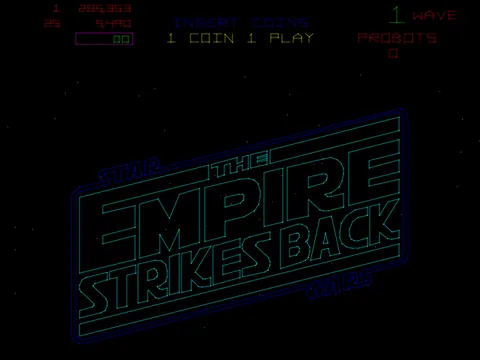
Technically The Empire Strikes Back built on Atari’s proven vector hardware and, like its model, made use of sharp wireframe models that lent both the space and ground combat a characteristic, almost dreamlike look. In its day it was an elegant way to conjure a sense of speed and depth on limited horsepower.
The game was released as an official sequel under the Star Wars license and aimed at players who had fallen in love with the first arcade title and wanted another helping of galactic action. Betting on instantly recognizable scenes from the film — especially the battle with the AT-AT — was a clever way to turn film viewers into players.
Today The Empire Strikes Back is an interesting shard of the history of the Atari-Lucasfilm partnership and a reminder of an era when vector graphics still held a firm place in arcades. For collectors and lovers of retro shooters it is a title worth trying.
Why play: A vector sequel to the Star Wars arcade game that pits you face to face with the walking AT-ATs in the icy battle of Hoth.
Game 17 of 258 for Arcade
The same title elsewhere (1)
The arcade original was built on vector graphics, just like the earlier Star Wars machine – thin glowing lines drew the walking AT-ATs and the Hoth landscape with a smoothness home computers of the era simply couldn't match. The Commodore 64 port had to replace those vectors with block-and-sprite bitmap graphics, giving the scene a chunkier look and a more limited color palette, but it let players experience the famous battle at home without feeding coins into a machine. For the original visual feel and smoothness, seek out the arcade version; the C64 port is more of a modest home reminder of the same battle.