Rogue
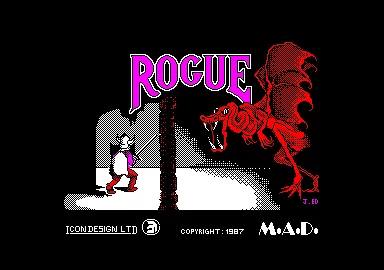
Rogue built the entire roguelike genre on two pillars: the multi-level dungeon is randomly generated on every run, so no two games are ever alike, and character death is final, meaning the player can't undo a mistake by loading an earlier save. The original version on university Unix computers was programmed by Michael Toy, Glenn Wichman, and Ken Arnold, who, after adding a save feature, immediately programmed the save file to be deleted the moment it was reloaded, so players couldn't get around character death by repeatedly reloading. Along the way, the player finds weapons, armor, scrolls, potions, and rings whose effects are often only discovered by trying them. The goal is to descend as deep as possible in search of the Amulet of Yendor, all while managing the character's hunger, and to return to the surface alive with the treasure — something that, thanks to randomness and rising difficulty, only rarely succeeds, and it's exactly this tension that keeps the genre alive to this day.
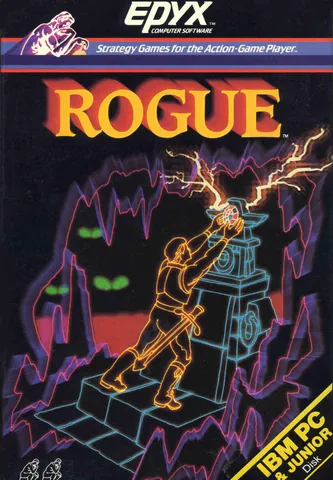
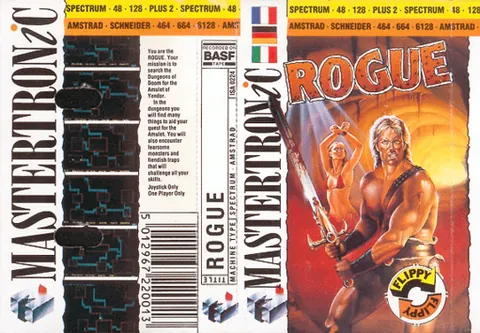
The Amstrad CPC version was made in 1988 by Icon Design for publisher Mastertronic, alongside parallel ports for the ZX Spectrum and Commodore 64 — part of the same family of European budget ports, separate from the earlier American versions for DOS, Macintosh, Amiga, and Atari ST made several years earlier by a different development team. The graphics match the capabilities of the eight-bit Amstrad, and the controls were adapted for the computer's keyboard, but the rules, dungeon generation, and permanent death all remained the same as in the original version. It wasn't a content expansion or simplification of any kind, just a way to bring the game to a wider circle of European players at a low budget price in a cassette box, including the need to identify unknown items by trial and error on the fly.
Why play it: For Amstrad CPC owners, this version offers exactly the classic, merciless dungeon that kicked off the entire roguelike genre, in an accessible, cheap budget package from the late 1980s.
Game 26 of 26 for Amstrad CPC