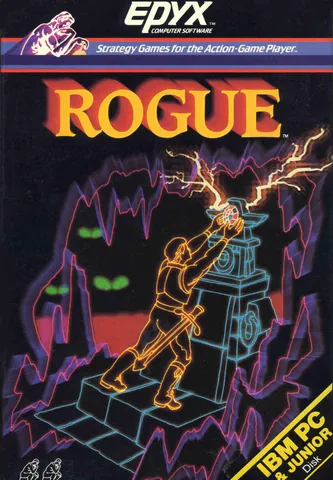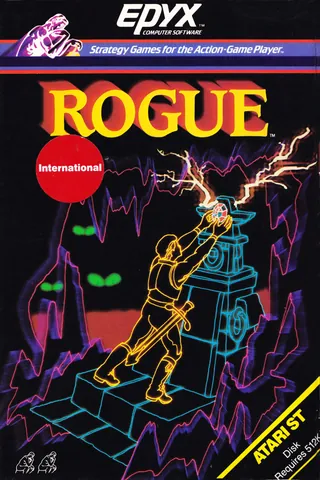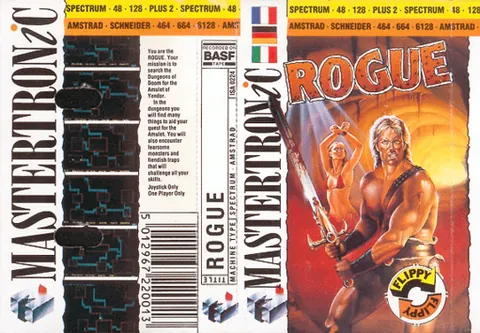
Rogue
Rogue is one of the founding games of the roguelike genre: the player descends into a randomly generated, multi-level dungeon, fights monsters, manages their character's hunger, and collects weapons, armor, scrolls, potions, and rings whose effects are often only discovered by trying them — but once the character dies, the run ends permanently, and the next attempt starts with a completely different map and threat layout. The original was created on university Unix computers by programmers Michael Toy, Glenn Wichman, and Ken Arnold, who, after adding a save feature, immediately programmed the save file to be deleted the moment it was reloaded, so character death couldn't be sidestepped. This uncertainty, the lack of any way to reload an earlier position, and the need to think through every step are the main reasons the game remains influential decades later and why it's called the founder of the entire genre.
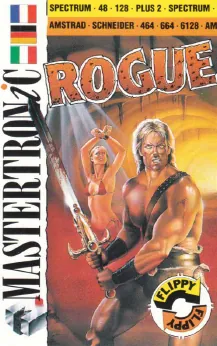
On the Commodore 64, the game didn't arrive until 1988, taking a different path from the earlier ports for DOS, Macintosh, Amiga, or Atari ST — this version was made by Icon Design for British budget publisher Mastertronic, alongside parallel versions for the ZX Spectrum and Amstrad CPC. It's therefore a separate port, independent of the older American team A.I. Design, made several years later and aimed at the European budget market with cheap cassettes sold in newsstands and electronics shops alike. The graphics stayed simple and suited to the capabilities of the eight-bit machine, with a color palette typical of the Commodore 64, but the core of the game — dungeon generation, turn-based combat, and permanent death — was unchanged from the older Epyx port, as was the need to identify unknown items by trial and error.
Why play it: This version will appeal to C64 owners who want a classic roguelike without needing to reach for the pricier American original — gameplay-wise it's still the same merciless dungeon, just in a cheaper European package.
Game 115 of 121 for Commodore 64