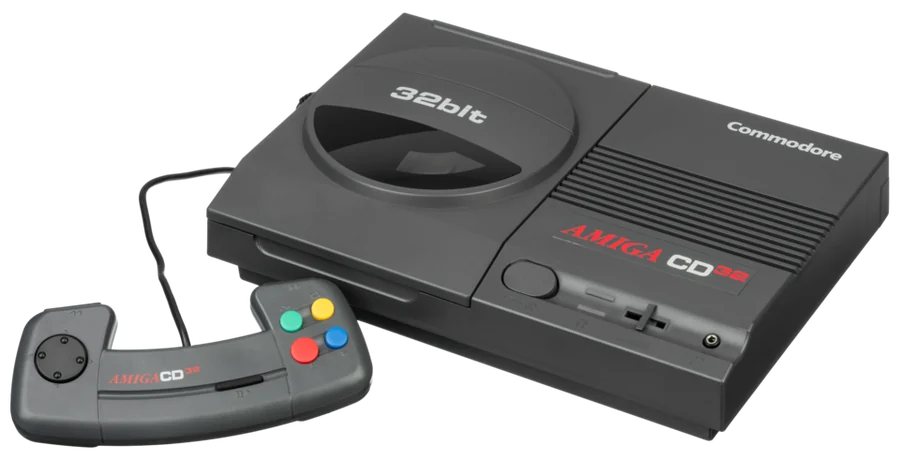
 Commodore · 1993
Game consoles
Amiga CD32
History & context
When Commodore unveiled the Amiga CD32 in the autumn of 1993, it was a bold attempt to turn the Amiga home computer into a living-room game console. From a technical standpoint it was nothing brand-new from the ground up: at its core the CD32 was an Amiga 1200 supplemented with a CD-ROM drive and stripped of its keyboard and floppy drive. Even so, the console deserves an honorable place in history — it is often described as the world's first 32-bit game console with a CD drive, one that reached the market before the Atari Jaguar with its CD as well as the later Sega Saturn and Sony PlayStation.
Commodore was desperate for a hit. The company was drowning in debt, sales of the classic Amigas were falling, and the CD32 was meant to be the lifebuoy that would draw players toward the medium of the future — the compact disc. In Europe, where the Amiga had an enormous installed base, the console sold decently and for a while became very popular. But the story ended quickly and sadly: because of a patent dispute and manufacturing problems, Commodore went bankrupt in the spring of 1994 and the CD32 passed into history after only a few months on the market.
Technology: graphics and sound
At the heart of the CD32 is a Motorola 68EC020 processor clocked at 14.18 MHz and 2 MB of Chip RAM. Graphics are handled by the AGA (Advanced Graphics Architecture) chipset, the same as in the Amiga 1200. It can work with a palette of 16.8 million colors, while it can render up to 256 colors on screen at once in indexed mode, or 262,144 colors in the special HAM8 (Hold-And-Modify) mode. Standard game resolution hovered around 320×256 pixels (PAL), though AGA could handle higher modes too.
The Amiga was renowned for its specialized coprocessors — the Blitter for fast moving of graphics blocks, the Copper for controlling the image line by line, and hardware sprites. Thanks to these, smooth scrolling and color gradients stood out, things that required far more effort on competing machines.
Sound is provided by the legendary Paula chip with four hardware channels and 8-bit PCM playback of samples (sampled sound), split classically into stereo pairs. Above-average sound for its time was one of the great strengths of the entire Amiga line. The CD drive also made it possible to play music directly from an Audio CD, and the console worked as an ordinary CD player too.
Connectivity and peripherals
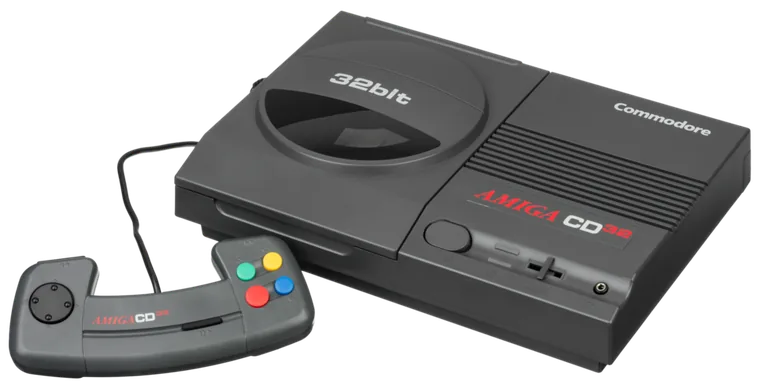
The CD32 had a two-button gamepad (with a D-pad, two action buttons, buttons for browsing and pause), connectable to two ports. There was a composite video and RF output for connecting to a television, and on some variants also S-Video.
An interesting chapter is the FMV (Full Motion Video) module peripheral, which slotted into the expansion connector and added hardware decoding of MPEG-1 video, so the owner could play films from Video CD (VCD) and CD-i format discs. The console also had an expansion connector, through which projects existed to turn the CD32 back into a full-fledged computer (adding a keyboard, floppy drive, mouse and serial port) — effectively creating devices close to the Amiga 1200.
Models and revisions
The CD32 was made in essentially a single basic form, differing mainly in regional versions for PAL (Europe, Australia) and the planned NTSC versions for North America. The North American market, however, the console practically failed to reach — because of a patent dispute with Cad Track (concerning XOR rendering), Commodore's imports were blocked and a large part of the stock got stuck in warehouses, which was one of the nails in the coffin of the whole company.
In hardware the CD32 is so close to the Amiga 1200 that a large part of the software and know-how was transferable between the two machines. That, incidentally, explains why many games arose as simple conversions of Amiga titles to CD.
Clones and variants
No official clones of the CD32 were made — Commodore went bankrupt before the market could develop, and the brand was later acquired by another company. There are, however, modifications and expansion kits made by enthusiasts that turn the console into a computer, or address the faulty internal battery and the replacement of the outdated CD drive with a modern solution.
As for the Czechoslovak trail, it is tied more to the whole Amiga family than to the CD32 directly: both eight-bit and sixteen-bit Amigas had a devoted community of users here in the 1990s, the Amiga demoscene was extraordinarily lively, and the machines were imported here in large numbers. The CD32 itself was rather a rarity here because of its price and short lifespan — all the more prized among collectors.
Today's scene
The CD32 lives on splendidly today thanks to emulation. Emulators like WinUAE (and its variants for various platforms) can faithfully simulate the AGA chipset and the CD drive, so you can play the titles on a PC as well as on more powerful handheld emulation devices. The community around the Amiga is one of the most active in the retro world — new homebrew games, demo productions and hardware add-ons (drive replacements, flash solutions instead of CD) are being created. For collectors the CD32 remains an attractive piece: a reminder of the time when Commodore made its last attempt to conquer the living rooms — and almost pulled it off.
Games on this platform (10)

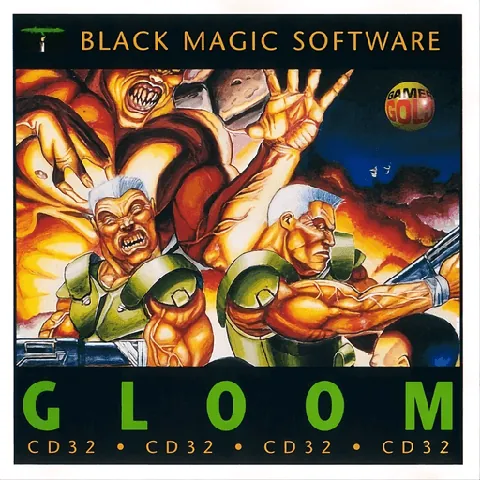
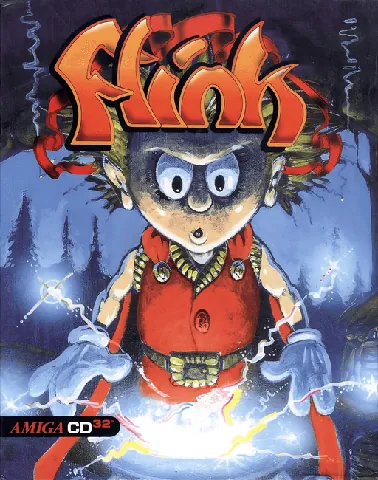
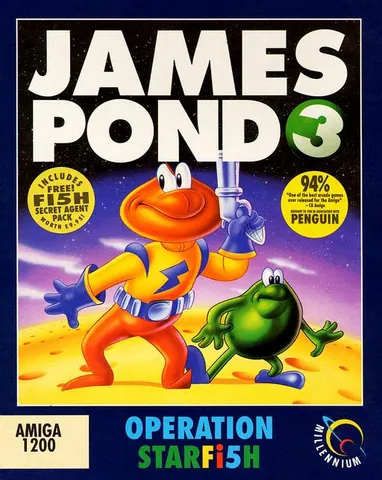
No game in this genre.