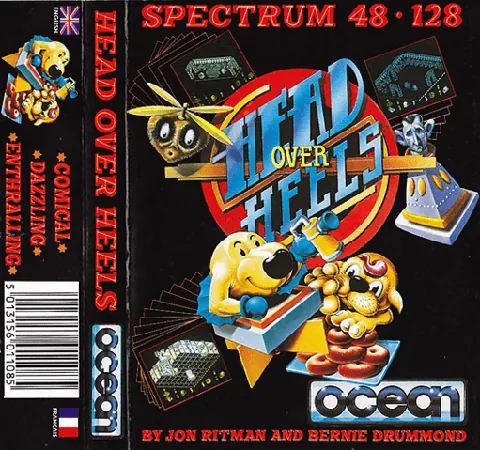
Head over Heels
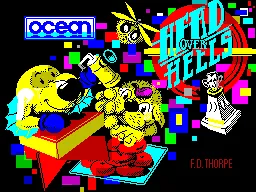
Two characters, one solution - and you have to think for both at once. Head over Heels took the Spectrum's isometric tradition and pushed it into territory where a spatial puzzle becomes a small, touchingly clever game about cooperation.
You control a duo of heroes: Head and Heels, who have different abilities. One can jump higher and shoot, the other runs faster and can carry a load. On their own they can only handle part of the tasks, but when they join into a single unit they can combine their skills and reach places neither could ever get to alone. The whole game is built on switching between the characters, sending them along different routes and then joining them again to overcome obstacles that are unsolvable for just one.
It was released in 1987 under the Ocean banner and represents one of the peaks of the so-called filmation genre that Knight Lore had launched. Head over Heels, however, enriched it with a layer of logical design built on the interplay of two distinct entities - an idea that was unusually sophisticated at the time and today would readily be called a cooperative puzzle for a single player.
What is likeable about the game is not only its ingenuity but also its tone. The world is full of charming details, funny enemies and a playful atmosphere that contrasts with how unexpectedly demanding some rooms can be. You gradually unlock interconnected areas, learn the possibilities of both characters and experience the satisfying feeling of finally figuring out how to coordinate them.
Among Spectrum connoisseurs, Head over Heels has a reputation as one of the best-designed titles on the entire platform. It is proof that the isometric genre did not have to be merely a technical showcase, but could be a full-fledged logic game with a heart of its own.
Why play: For an elegant puzzle game where you steer two characters with different abilities - a clever, endearing and surprisingly deep peak of the Spectrum's isometric era.
Game 4 of 100 for ZX Spectrum
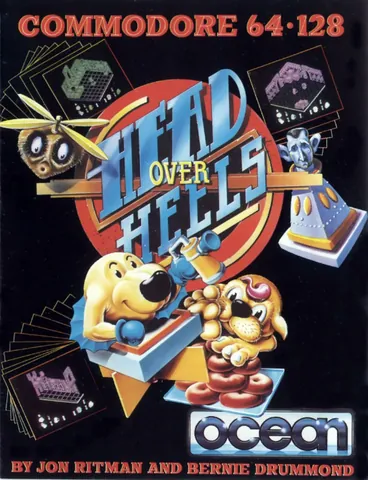
The same title elsewhere (2)
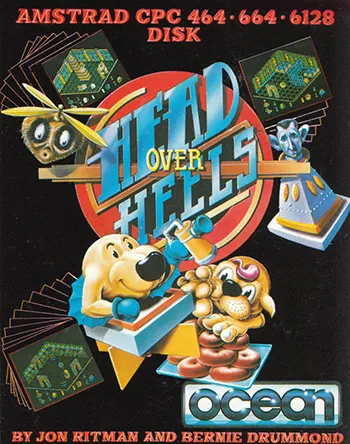
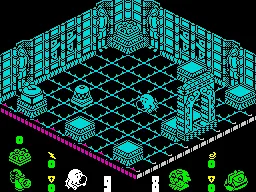
Both home versions come from the same design, but they differ mainly in color and visual clarity. Thanks to its graphics chip, the Amstrad CPC had access to a wider color palette without the typical color-clash between neighboring objects, so its isometric rooms look cleaner. The ZX Spectrum version has to deal with the well-known attribute clash, a limit on colors per screen block, so characters and scenery often blend into the background. Gameplay and the scope of the puzzles remain identical on both machines — the difference is purely visual, and anyone who prefers a nicer-looking picture should pick the CPC version.