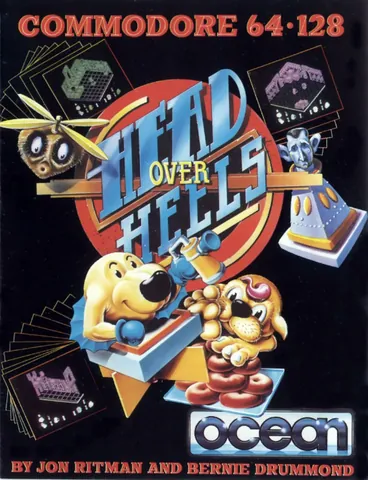
Head Over Heels
Head Over Heels, by the duo Jon Ritman and Bernie Drummond, was released on the Commodore 64 in 1987 as an isometric action-adventure in which the player controls two distinct characters, Head and Heels, who must first be found and then merged into a single, more powerful being. Head can jump higher and attack with a freezing breath, while Heels is faster and can carry objects — once the two characters are joined the player gains a combination of both abilities, but also both of their vulnerabilities, so part of the game can also be solved by splitting the characters back apart to tackle specific puzzles that depend on their differing strengths.
The game world is divided into four sprawling planets full of rooms connected by lifts, teleporters and hidden passages, where the player solves logic puzzles based on collecting items in the right order, moving crates, and using both characters' abilities. On the C64 the game excelled with precise isometric graphics in bold colours and smooth animation, making it one of the technically most advanced games of its kind on the platform, and it demonstrated well how skilfully the developers worked within the machine's limited memory. Music was used sparingly; the game placed its main emphasis on sound effects and the atmosphere of a quiet, precisely designed world of puzzles and traps.
Head Over Heels is still considered one of the high points of the isometric action-adventure genre of the 1980s, and its well-thought-out design, in which both the gameplay and the puzzles grow directly out of the two-character-merging mechanic, influenced a number of later games of this type. The game demands patience and systematic mapping of its world, but rewards the player with the feeling of elegantly solving complex spatial puzzles. Even decades later it remains among the titles regularly cited as proof of the creative peak of the British game scene of the 1980s and as an inspiration for the later genre.
Why play it: For players who enjoy elegantly solving spatial puzzles, Head Over Heels is one of the high points of 1980s isometric action-adventures, even though it demands patience and systematic mapping.
Game 72 of 121 for Commodore 64
The same title elsewhere (2)
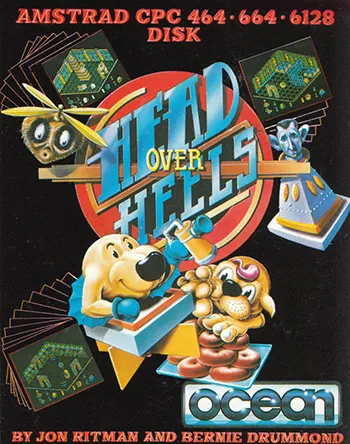
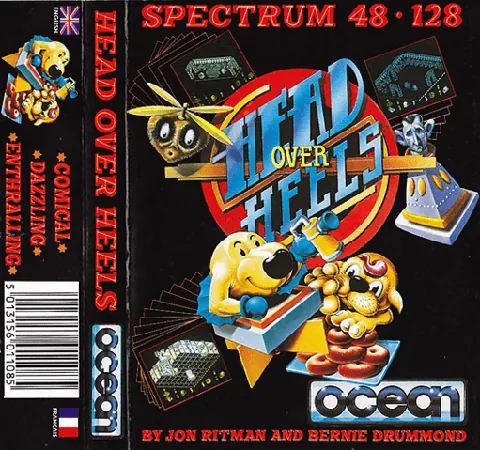
Both home versions come from the same design, but they differ mainly in color and visual clarity. Thanks to its graphics chip, the Amstrad CPC had access to a wider color palette without the typical color-clash between neighboring objects, so its isometric rooms look cleaner. The ZX Spectrum version has to deal with the well-known attribute clash, a limit on colors per screen block, so characters and scenery often blend into the background. Gameplay and the scope of the puzzles remain identical on both machines — the difference is purely visual, and anyone who prefers a nicer-looking picture should pick the CPC version.