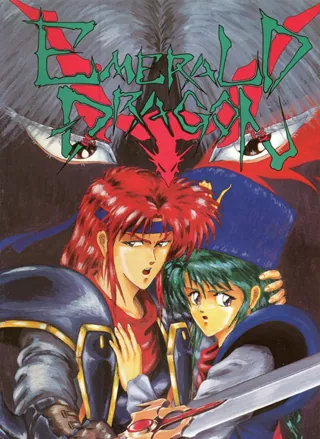
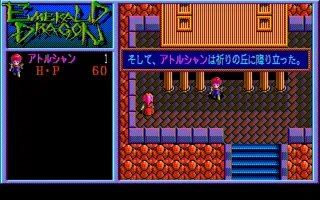
Emerald Dragon belongs to the titles that pushed Japanese computer RPGs toward cinematic storytelling. The story of a dragon hero who takes on human form, and the girl bound to him by an ancient promise, builds on relationships between characters and on long dialogue passages accompanied by large drawn portraits. The game doesn't try to be an open world to explore; it leads the player along a precisely defined path and rewards them with scenes that, at the time, felt closer to anime than to a computer game.
Battles take place on a separate combat screen and have their own quirk: the player directly controls the main character, while allies act according to their personalities and set instructions. This means less micromanagement and more attention to positioning and attack timing, but it also means the player has to learn what their companions understand and what not to ask of them. On the PC-98, the game mainly capitalized on its visual side — carefully drawn portraits and colorful backgrounds make full use of the high resolution and rank among the best the genre produced on this platform. The music is romantic and orchestrally styled, with distinctive themes tied to individual characters.
At the time it was praised precisely for its presentation and storytelling, and it became one of the reasons Japanese computer RPGs began to be compared with console competitors. It was later released in remade versions on consoles, which expanded the story scenes even further. Today Emerald Dragon is interesting as evidence of how early Japan embraced the idea of the RPG as a told drama — the gameplay is simpler than that of its dungeon-crawling rivals, but that's exactly why it can still be finished today without a major fight against the interface. Its weakness lies precisely in the limited control over the party, which can feel wilful in tougher encounters, and in its linearity, which leaves little room for personal discovery. But anyone coming for the story and the artwork will get one of the most visually accomplished games on the entire platform.
Game 20 of 28 for NEC PC-98