Touhou Fuumaroku ~ Story of Eastern Wonderland
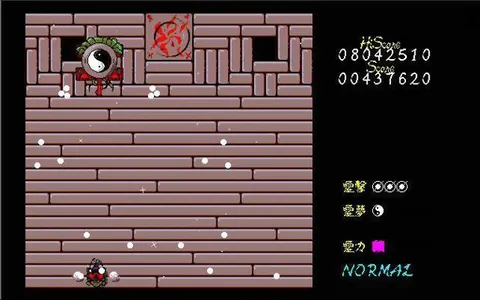
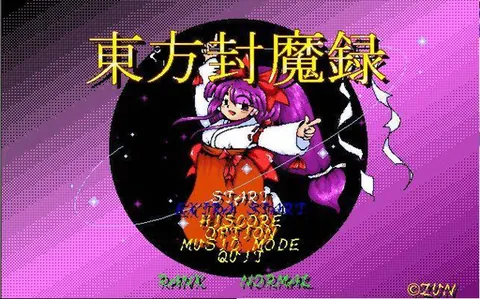
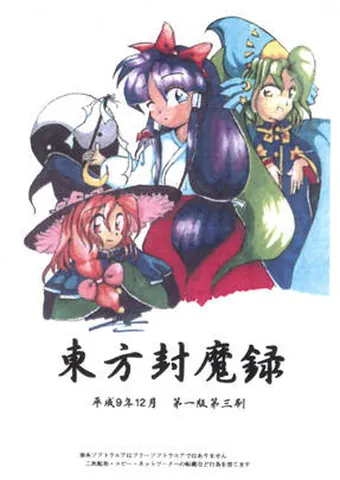
Touhou Fuumaroku ~ Story of Eastern Wonderland is the second game in the series and also the moment Touhou found its true form: a vertical shooter with bosses attacking in elaborate bullet patterns. This time Reimu Hakurei flies on the back of the old turtle Genjii, investigating who is sending a wave of supernatural visitors to the Hakurei Shrine. Before starting, the player chooses a type of armament, which changes both the width and power of the shots, and together with a limited number of magic attacks determines how well they'll handle the densest sections.
The structure is classically arcade — five levels ending in a boss fight, plus a bonus level for those who beat the game without using a continue. The bullet patterns are simpler than in later games, but faster and less forgiving, since the character's hitbox isn't yet as tiny as in later titles. On the PC-98 the game had to fit within the platform's modest capabilities while still keeping dozens of bullets moving smoothly at once, which it managed thanks to economical yet legible graphics. The music uses FM synthesis, and even here you can already hear themes the series would carry forward, ones fans still recognize decades later.
The second game is also the first to feature a cast of distinctive female opponents each with their own personality — this very principle is what turned Touhou into material for an endless stream of fan works. At the time it was still a doujin game distributed outside regular stores, but today it's one of the most-played titles in the entire PC-98 library. Anyone who wants to understand why the series became a phenomenon should start right here: this is the first true Touhou. Finishing it takes under an hour, but clearing it without losing a life is a matter of many attempts — and that's exactly where its greatest appeal lies: the game is short, can be picked up any time, and can always be played a little bit better. Today it's best treated as the historical foundation — later entries are more polished, but this is where the vocabulary the whole series still speaks was born.
Game 25 of 28 for NEC PC-98