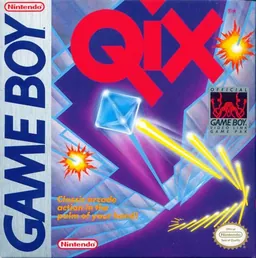
Qix
There are games that explain their rules to you in five seconds and then hold you at the screen for hours. Qix is exactly such a case. No story, no heroes, no jump-scare bosses — just an empty area, your line and the compulsive urge to claim more than is wise.
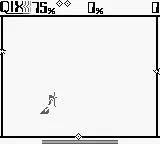
The principle is geometrically clean. Your marker moves along the edges of the playing field and draws enclosed shapes. Once you close off a piece of the area, it is yours, and the percentage counter climbs. The goal is to claim a predetermined share of the whole — and therein lies all the devilish charm. You can draw small, safe segments and advance cautiously bit by bit, or sweep across half the screen and risk everything. For across the field bounces the titular „Qix“, a chaotic, undulating entity, and along the edges of your unfinished lines other enemies creep. Until you close the line, you are vulnerable. Every big claim is thus a gamble: the longer the move, the greater the reward and the danger.
Qix originated as an arcade cabinet back in 1981 at the Taito studio and belongs to that rare category of games that are literally timeless, because they rest not on graphics or technology but on abstract mathematical tension. Here we have it in the form of a Game Boy port from 1990, and the monochrome handheld suits this game incredibly well. No colors distract — all that remains is the tension between risk and safety, reduced to pure lines and percentages.
What makes Qix so hypnotic is the rhythm it draws you into. For a while you calculate, waiting for the right moment, tracking the path of the Qix — and then you steel yourself for a risky cut across the open space, your heart leaps as your marker races across the field and you hope you can close the shape before something hits you. It is the pure essence of „just one more round“ gameplay, where every loss is your own fault and every win a small victory over your own impatience.
The game also has its tactical layer, which those who sink into it more deeply will appreciate. What matters is not only how much area you claim, but also how fast you do it — slow, cautious drawing lowers your risk, but an unfinished line can usually be drawn at two speeds, where the slower one brings a higher score for the claimed area. So you learn to read the Qix's behavior, anticipate where the undulating entity will move, and exploit the moments when it draws away for bolder moves. From a simple game of claiming territory comes a duel of nerves and timing.
Qix is in its own way a game outside of time and genre pigeonholes. It is neither a classic platformer nor a logic puzzle in the usual sense — it is an abstract battle for territory that has little parallel even today. If you are looking for a title that will not burden you with story or a tutorial and instead offers you pure, focused gameplay for five minutes or an hour, here it is.
Why play it: A timeless abstract arcade game where every move is a gamble between greed and caution — easy to grasp, hard to put down.
Game 24 of 147 for Nintendo Game Boy