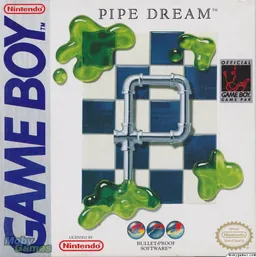
Pipe Dream
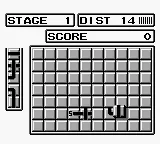

The water is already flowing and you are desperately laying more and more pieces of pipe to keep it running — welcome to one of the most stressful and at the same time most addictive puzzle ideas of the eighties and nineties. Pipe Dream took the simple idea of building a pipeline and turned it into a reflex-driven race against the clock that engulfs anyone who so much as touches it.
The mechanic is ingeniously understandable: you place randomly arriving pieces of pipe on a grid and try to assemble the longest possible continuous route before a liquid called „flooz“ starts pouring from the outlet. Once the liquid sets off, it flows relentlessly through the pipe you laid — and if it hits a dead end, it is over. So you have to plan ahead, improvise with whatever the game happens to offer you, and make peace with the fact that the perfect route almost never works out. From this springs that characteristic feeling of pleasant tension, where every decision by a single square is a gamble.
The game originally emerged on home computers and was ported practically everywhere — on the Game Boy it found a great home, because it fits precisely into short sessions on the go. A few screens and you realize half an hour has already passed.
The most interesting thing about Pipe Dream, though, is its cultural footprint. The principle of building a pipeline became so iconic that it turned into a fundamental building block of countless „mini-puzzles“ in later games — from hacking and lockpicking minigames to more complex systems. Most famously it was popularized by BioShock, where the „pipe minigame“ became the main way of hacking. Few puzzles from that era left such a broad footprint.
Pipe Dream is thus a rare case of a simple game that became a language — a visual shorthand understood even by players who never played the original.
Why play it: A simple yet nerve-wracking and endlessly addictive puzzle whose pipe-building mechanic you know from dozens of later games; the ideal little stressor for your pocket.
Game 23 of 147 for Nintendo Game Boy
The same title elsewhere (1)
The original PC/DOS version targeted a wide range of machines — from simple XTs with a PC speaker to more powerful 486s with sound cards like Sound Blaster — so the music, effects and even the color palette varied from machine to machine. The 1990 Game Boy version runs only in shades of green-gray on a small screen, giving players a more limited overview of the playing field. The core idea of laying down pipes stays the same, though, and both platforms are equally addictive — the Game Boy adds the advantage of playing anywhere, while a well-equipped PC delivers a more colorful, smoother experience.