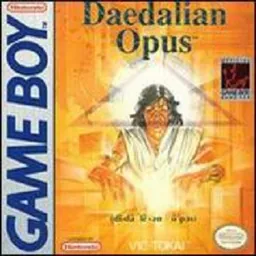
Daedalian Opus
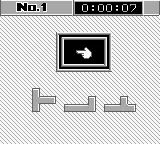
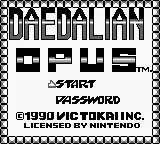
Some games want to beat you. Daedalian Opus wants to calm you down. At a time when the Game Boy was flooded with action platformers and hard-edged arcades, 1990 saw the release of this unassuming title from Vic Tokai, which offers not a single enemy, not a second of time pressure — just you, a grid, and a handful of geometric shapes.
At its core is the pentomino, a classic mathematical puzzle. A pentomino is a shape made of five squares, and there are twelve distinct varieties. Your task is to arrange these pieces into a pre-drawn figure so that they fit together perfectly, with no gaps and no overlaps. It sounds simple, but as the number of pieces grows and the target shapes get more complicated, you discover that every solution demands patient rotating, flipping, and thinking about space several moves ahead. It is a puzzle in the purest sense of the word — no tricks, just geometry and logic.
Daedalian Opus is a curiosity for several reasons. The pentomino is one of the oldest recreational mathematical puzzles, yet the number of video games that treat it as their main dish is literally a handful. That makes this one of the very few purely „pentomino“ titles ever released, and that alone makes it a point of interest for collectors and for puzzle lovers looking for something off the beaten path.
What you will appreciate about this game is its absolute honesty. There is no score to stress you out, no timer breathing down your neck. You sit with the console, slide the pieces around, and when you finally manage to close off a figure, you get that quiet, satisfying feeling of a problem solved. It is a game ideal for winding down in the evening, for a train journey, or for a moment when you want to clear your head with a single, clearly defined task.
What makes Daedalian Opus especially welcoming is its gradual buildup. The game does not throw you straight into the hardest puzzles — it starts with simple figures and a few pieces, and only gradually adds more complex shapes and less intuitive layouts. In doing so it gently teaches you to think in pentominoes, to recognize which piece goes where, and to anticipate how the remaining gaps will be filled. It is a learning curve that respects the player and lets them grow alongside the difficulty rather than frustrating them. By the end you will be rotating shapes in your head before you ever place them on the grid.
In the context of handheld gaming, Daedalian Opus is proof that the Game Boy was not only a platform for reflex-driven action, but also for quiet, contemplative puzzles. It is not a title that will jolt you with adrenaline — it is more of a repose, a meditation on geometry. And in today's flood of noisy games, such an unassuming, calm puzzler has an unexpected charm.
Why play: A rare, purely pentomino puzzle with no stress and no timer — geometric meditation for anyone who wants to clear their head.
Game 25 of 147 for Nintendo Game Boy