Pipe Dream
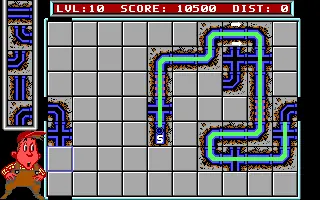
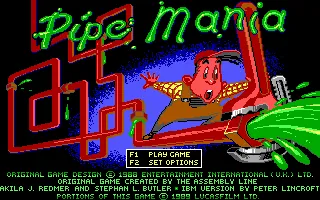
Pipe Dream, also known in Europe as Pipe Mania, casts the player as a plumber who has no time to plan ahead. Randomly selected pipe sections appear on a grid, and the player lays them down one after another, trying to build the longest possible continuous line from a given starting point. After a short delay, sticky green sludge starts pouring from the outlet, and from that moment it's a race against time: if the player fails to place the next piece before the liquid reaches it, the round ends. The tension comes from the queue of upcoming pieces, which can't be argued with, forcing the player to improvise and often lay pipes over already placed sections to save a route that's heading into a dead end.
The DOS version is beautifully economical. A static grid, strong color-coding for the different pipe types, and a smooth animation of the rising fluid level are enough for the player to instantly know how many seconds remain. It can be controlled with either mouse or keyboard, and switching between them is a matter of habit, since in later rounds every single movement matters. Obstacles gradually pile up — fixed junctions, flow accelerators, and tiles where building isn't allowed — turning what started as a calm puzzle into a game about fast spatial thinking. The sound stays functional and unobtrusive, with the bubbling countdown of the approaching sludge playing the lead role.
At the time of release, the game became one of the classic titles of so-called office gaming, since it could run on any PC and a single round only took a moment. But its mechanic settled in far more deeply: the scheme of laying pipes under time pressure later showed up in dozens of minigames, hacking sequences, and puzzles embedded inside larger games, where it serves as shorthand for repairing or breaking into a system. Booting it up today, it still works surprisingly well. The rules are instantly readable, the rounds are short, and the urge to try just one more, slightly longer route is just as strong as it ever was.
Game 92 of 204 for PC / DOS (XT až 486)
The same title elsewhere (1)
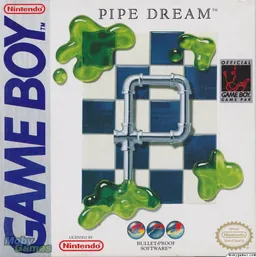
The original PC/DOS version targeted a wide range of machines — from simple XTs with a PC speaker to more powerful 486s with sound cards like Sound Blaster — so the music, effects and even the color palette varied from machine to machine. The 1990 Game Boy version runs only in shades of green-gray on a small screen, giving players a more limited overview of the playing field. The core idea of laying down pipes stays the same, though, and both platforms are equally addictive — the Game Boy adds the advantage of playing anywhere, while a well-equipped PC delivers a more colorful, smoother experience.