Asteroids
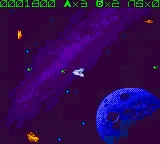
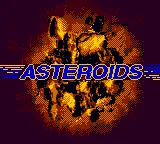
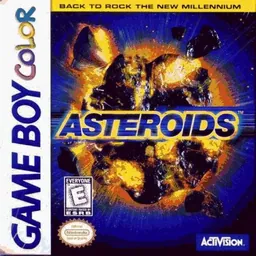
Asteroids for the Game Boy Color from 1999 brings another iconic arcade classic to the handheld console, this time from Atari's 1979 production, prepared for the GBC by Digital Eclipse, a studio specializing in faithful remakes of old games. The player controls a small spaceship floating freely in weightless space, shooting and breaking up incoming asteroids into smaller pieces, dodging their debris, and occasionally facing enemy saucers as well. The movement physics, with its characteristic momentum and the need to rotate the ship rather than steer it directly, remains true to the original and still presents a distinctive challenge different from most later shooters. The ship also has a short hyperjump that can teleport it away from immediate danger in an emergency, though with the risk of reappearing directly in the path of another asteroid.
The graphics were slightly reworked for the GBC's color display, but the basic vector character of the game, the thin outlines of the ship and rocks, was preserved. The gameplay is built on the simple principle of surviving as long as possible and racking up the highest possible score, with more asteroids and faster opponents arriving as the waves progress. The game also offers bonus lives for reaching a certain point count, which encourages careful, deliberate play instead of reckless firing. The compact two-button-and-d-pad controls proved surprisingly well suited to the small console.
At the time of release, it was one of several arcade ports with which Activision supplied the GBC alongside newer licensed titles, and reviewers praised above all the accuracy of the conversion and the timelessness of the game principle itself. Today, Asteroids on the GBC is interesting mainly as proof of how well a purely abstract arcade concept from the late seventies fit into a pocket format two decades later, without losing its charm and addictiveness. Simple rules, no story, and a purely score-driven motivation make it a title one can return to for a few minutes at any time, without having to deal with progress or a saved position.
Game 108 of 129 for Game Boy Color
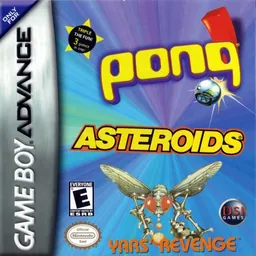
The same title elsewhere (2)
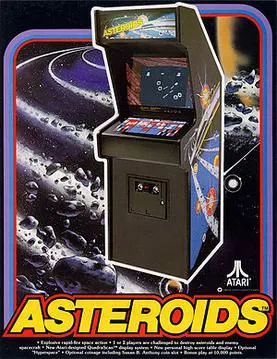
The Atari arcade original ran on a genuine vector monitor that drew thin, crisp lines for the ship and rocks directly with the electron beam, so the image stayed clean regardless of resolution. The Atari 2600 has no vector display — its picture is built from the blocky raster shapes typical of the TIA chip, so ships and rocks look coarser and less elegant. The console can also only show a limited number of objects at once, so asteroid density and pacing had to be toned down compared to the arcade. Sound is simple on both sides, but the synthesized explosions and the rising engine pulse from the arcade board carry more atmosphere. For the true vector cleanliness, the arcade version is where to go.