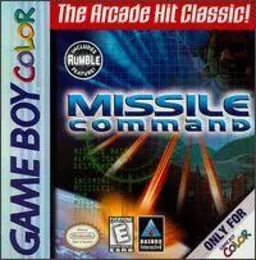
Missile Command
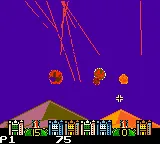
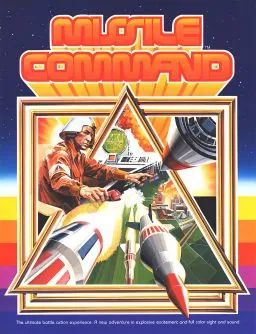
Missile Command was released on the Game Boy Color in 2000 as a port of the strategically minded Atari arcade classic from 1980, again from the workshop of studio Digital Eclipse. Unlike most shooters in this overview, the player here doesn't sit in a ship's cockpit but controls three anti-missile batteries defending six cities from a rain of ballistic missiles falling from the top of the screen. The goal is to place explosions precisely in the path of the enemy missiles before they land and wipe another city off the map. After all the cities are destroyed, the game doesn't simply end but opens a bonus round in which surviving inhabitants are counted, which further reinforces the sense that this game is really about something more than just a score.
The game builds tension between limited ammunition, reaction speed, and the need to decide which city needs to be defended first, since saving absolutely everything is practically impossible. As the waves progress, faster missiles, split warheads, and bombers are added, so even the seemingly simple principle of clicking on a target quickly turns into a hectic management of crisis situations. On the GBC, the controls were adapted to the d-pad and buttons instead of the original trackball, which slows the game down slightly but does not fundamentally change its core.
The atmosphere is rounded out by a sparse but effective soundscape of explosions and wailing sirens, which reinforces the sense of an approaching catastrophe typical of the game's Cold War inspiration. Missile Command on the GBC was appreciated mainly by players seeking a more strategic variant of the arcade shooter, one where decision-making and anticipation matter more than pure firing speed. Even today, it remains a remarkably tense concept that proves the shooter genre doesn't have to rely solely on fast firing but can also rest on cool tactical judgment. It is precisely this unusual, defensive point of view that makes it a refreshing change of pace on the handheld console, alongside a host of classic shooters focused purely on attack.
Game 110 of 129 for Game Boy Color
The same title elsewhere (1)
The 1980 arcade original was controlled with a precise trackball that let players sweep and fine-aim across the whole screen in an instant — which is why it's still regarded as the smoothest and best-looking version. The Atari 2600 port had to replace the trackball with a joystick, making aiming noticeably slower and coarser, and the graphics lost color and detail due to the console's weaker hardware. The Atari 5200, on the other hand, offered an analog controller whose range came much closer to the trackball, so its controls felt far closer to the arcade original than the 2600's did, and many players rank it among the best home ports ever, even though its colors and smoothness still fall short of the arcade.