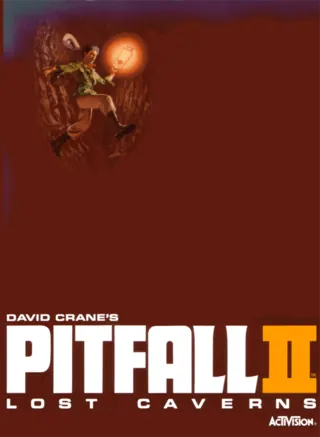
Pitfall II: Lost Caverns
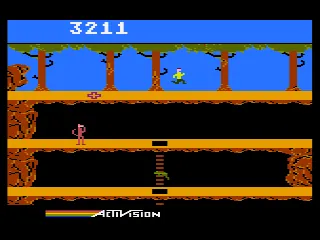
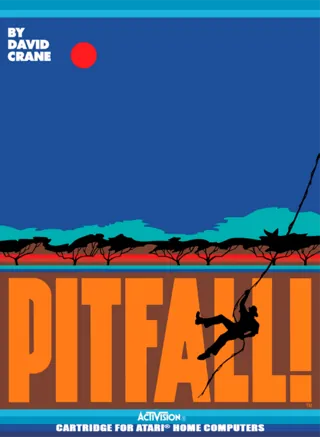
Pitfall II: Lost Caverns picks up from the original Pitfall! and moves Harry's adventure into branching underground caverns full of bats, snakes, and underground waters, where the player, besides jumping over obstacles, must also decide which way to go, since the map isn't just a linear track but a network of interconnected paths. New compared to the first installment is also the option to fly on a balloon over part of a level or dive underwater, which expands the movement options and gives the levels a vertical dimension unusual for early platformers.
On the Atari 8-bit, the game uses smooth scrolling, which represented a technically advanced solution at the time of release — instead of assembling the screen from static images, the environment shifts smoothly with the character's movement, giving a sense of a genuine, continuous underground world. The musical backdrop, which plays continuously through much of the game, was a fairly ambitious feat on the hardware of the time and contributed to an atmosphere of adventurous exploration rather than the tense pace of classic arcade games.
Pitfall II is often cited as one of the titles that pushed the boundaries of what was expected from a platformer on eight-bit home computers — it introduced a design elsewhere combining exploration, route planning, and smooth movement without jerky screen switching. Even decades later, the game remains playable and engaging thanks to a structure that rewards attention to the map and patient exploration of the individual branches of the cave system, which is why it's still recommended today as one of the showcase titles of the eight-bit Atari library. The combination of searching for hidden paths, collecting items, and smooth movement directly foreshadowed the genre's later development toward larger, interconnected game worlds, and that too is why Pitfall II is still remembered today as one of the more ambitious titles of its time. Its willingness to offer the player a choice of route and not rush them in one predetermined direction gave the gameplay a genuine sense of discovery that was missing from many contemporary platformers.
Why play: For players who appreciate an elaborate map and patient exploration of a cave system — Pitfall II is still recommended today as one of the showcase titles of the eight-bit Atari library.
Game 47 of 124 for Atari 800 / 8-bit
The same title elsewhere (3)
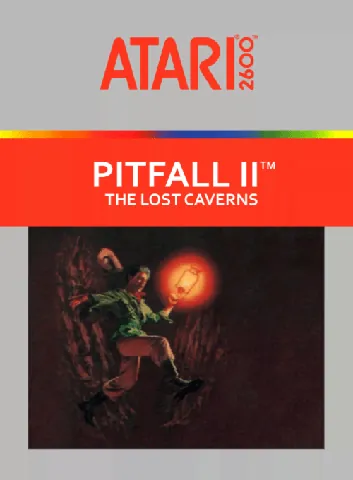
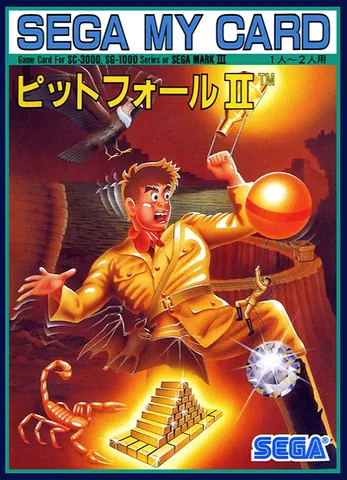
The Atari 2600 version owes its reputation to a special DPC chip built right into the cartridge, which let the console play multi-channel music far beyond what standard hardware could manage at the time, and also introduced the unusual idea of a game with no real death — Harry simply gets sent back after a fall. The 1985 SEGA SG-1000 port had no such special cartridge hardware to lean on, so it had to make do with the console's ordinary sound chip, leaving the music noticeably less rich. For the technical breakthrough and that distinctive sound, the Atari 2600 version is usually the one cited.