Pitfall II: Lost Caverns
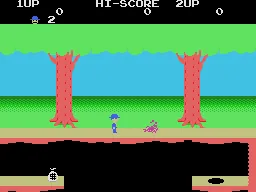
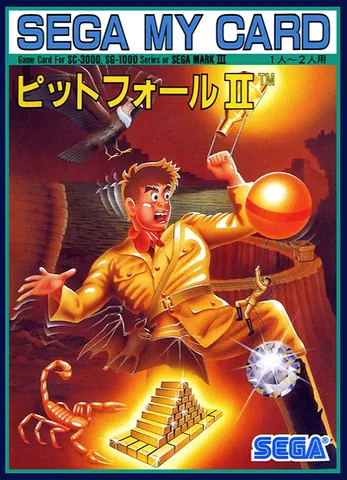
Pitfall II: Lost Caverns is one of the few SG-1000 titles to offer a genuinely large, interconnected world instead of a series of separate screens. Adventurer Pitfall Harry descends into a vast cave system to find his lost relative, her animal companion, and a treasure hidden deep underground. The caverns form one big map full of ladders, waterways, platforms, and endless bats, frogs, and other creatures, among which the player searches for the way forward as well as hidden side paths that are easy to miss.
The game solved the frustration problem in an elegant way that felt unusually forgiving for its release year. You don't have lives in the usual sense; after being hit, the game returns you to the last checkpoint reached and deducts points from your score. This turns Pitfall II into a gradual process of learning the terrain and memorizing routes rather than repeatedly starting from zero, a crucial difference for an exploration game. The SG-1000 version works within the console's capabilities, meaning simpler colors and rougher backdrops than later 8-bit ports, yet the layout of the caverns stays clear, and swimming through underground streams and free-fall drops still hold the tension. A continuous musical loop that changes with the situation is one of the series' distinctive traits.
The Activision original is considered one of the important steps toward action-adventures, and its influence on more open-structured games was considerable. The SG-1000 home version today offers several hours of exploration and a good feeling from gradually piecing together the map of the whole cave system in your head. It takes patience and a willingness to accept the control roughness of the time, but the reward is a game that, unlike most of the console's catalog, has a genuine beginning, middle, and end. For SG-1000 owners, this was, at the time of release, one of the few titles you could call an adventure spanning several evenings, and that's also why it's often remembered as one of the console library's high points.
Game 10 of 13 for SEGA SG-1000
The same title elsewhere (3)
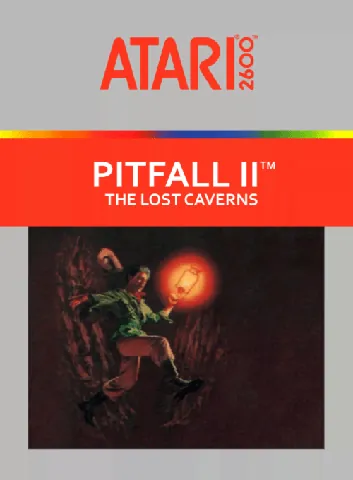
The Atari 2600 version owes its reputation to a special DPC chip built right into the cartridge, which let the console play multi-channel music far beyond what standard hardware could manage at the time, and also introduced the unusual idea of a game with no real death — Harry simply gets sent back after a fall. The 1985 SEGA SG-1000 port had no such special cartridge hardware to lean on, so it had to make do with the console's ordinary sound chip, leaving the music noticeably less rich. For the technical breakthrough and that distinctive sound, the Atari 2600 version is usually the one cited.