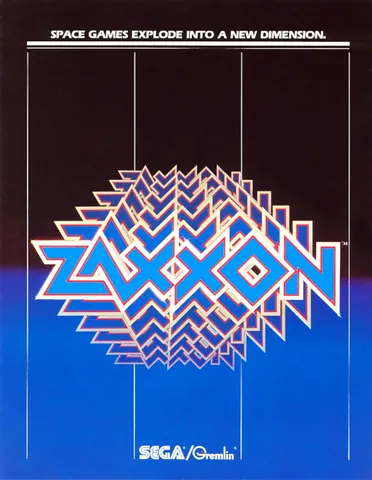
Zaxxon
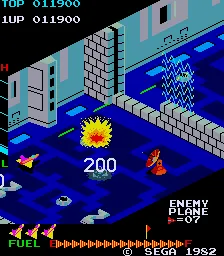
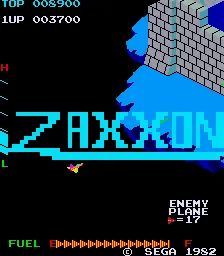
In 1982, Sega brought the title Zaxxon to arcades, one of the first mainstream arcade games to use isometric projection to create the illusion of real spatial depth. The player piloted a fighter jet flying over a fortified space base and had to constantly assess not only enemy positions left and right, but also flight altitude above the terrain, shown via a shadow cast on the ground below. This three-dimensional-feeling approach was groundbreaking at the time of release and set Zaxxon apart from the flat shoot 'em ups that then dominated arcades, games players could get by on with a single viewing direction.
Flying through the base required balancing between too low an altitude, which risked colliding with obstacles, and too high an altitude, which increased the risk of being hit by anti-aircraft fire. The player collected fuel necessary for survival and faced mounting pressure from enemy towers, missiles, and a final battle with the giant dragon Zaxxon, after which the game is named. The combination of precise spatial judgment and fast reflexes made it one of the most technically demanding games of its time, where a misjudged altitude often meant an instant game over.
Zaxxon is still remembered today as a pioneer of isometric rendering in arcade games, and it inspired a number of later titles that used the same trick to create a sense of depth on a two-dimensional screen. It's one of the games without which the history of arcade machines and their visual language would have been written differently.
Why play it: Because as one of the first titles it introduced an isometric view to arcade games and redefined how players perceived game space.
Game 137 of 258 for Arcade
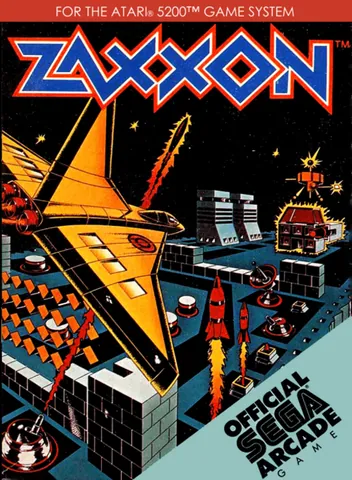
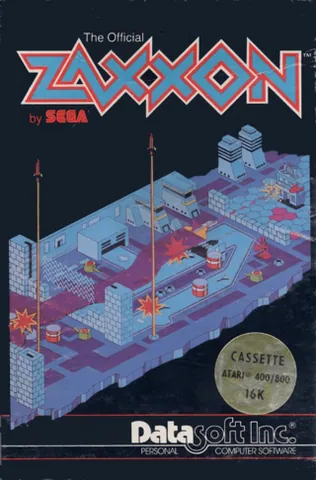
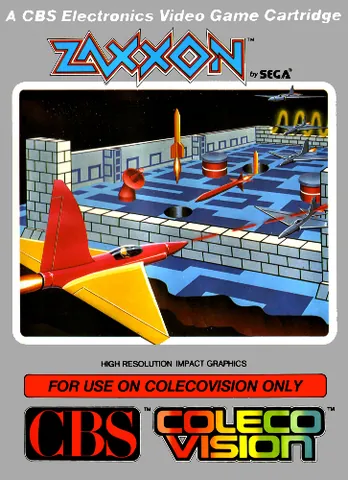
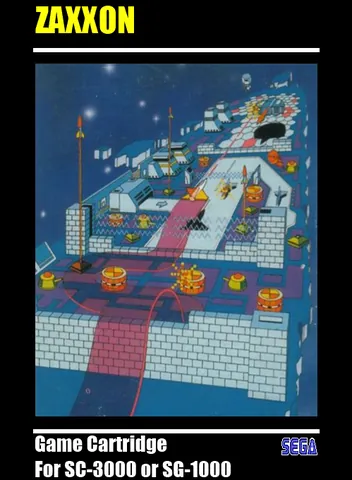
The same title elsewhere (4)
The 1982 ColecoVision version ranks among the best-regarded home conversions of the arcade original — the console managed to carry over the tilted isometric view and colour palette well enough that it felt almost like a little sibling of the arcade machine. The 1985 SEGA SG-1000 port had to cut back on far weaker hardware: fewer colours, coarser graphics and choppier background scrolling, so the sense of height and depth that Zaxxon relies on comes through noticeably weaker. Anyone wanting to feel why Zaxxon was a visual sensation in its day should reach for the ColecoVision version.