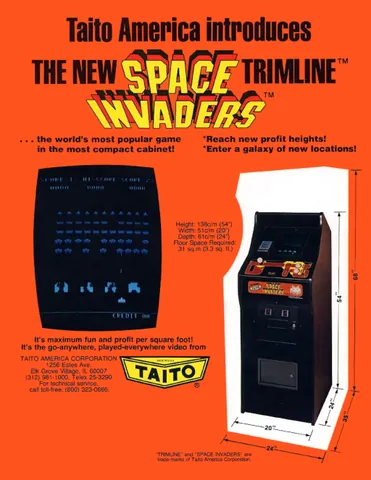
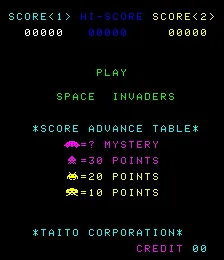
Space Invaders isn't just a game — it's the moment video games became a cultural phenomenon. When Taito unleashed Tomohiro Nishikado's cabinet into arcades in 1978, no one suspected it would spark a mania. In Japan the game supposedly caused such a hunger for coins that the amount of hundred-yen coins in circulation had to be increased — a story perhaps embellished, but one that perfectly captures the frenzy that erupted at the time.
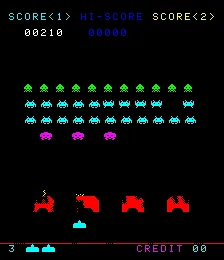
The principle is ingeniously simple: beneath rows of descending aliens you dodge behind four shields and pick off the attackers one by one. This is where the legendary mechanic was born — as the invaders dwindled, the hardware had fewer objects to render, so the remaining enemies sped up. Originally a technical limitation, it became one of the first true "difficulty curves" in history, and it still quickens players' pulses today. It's accompanied by that hypnotic, escalating "dun-dun-dun."
Space Invaders laid the foundation for the entire shooter genre and inspired countless followers. It established the high-score system as both a challenge and a social ritual. Retro gamers revere it as the forefather of everything — the invader silhouettes became a universal symbol of video games, recognizable even without playing a single round.
Game 75 of 258 for Arcade
The same title elsewhere (2)
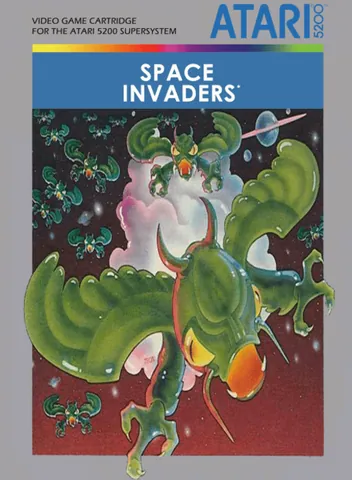
Taito's 1978 arcade original ran on a black-and-white monitor, with color coming only from strips of colored cellophane taped over the screen, plus the iconic four-note bass beat that sped up as the invasion closed in. The home port for Atari 2600 in 1980 had to simplify everything into blockier, fully colored sprites with less detail, yet it became the first officially licensed arcade conversion on a console and famously sold hardware — many bought a 2600 just to play it. In return it offered dozens of game variations (moving shields, invisible invaders, two-player mode) the arcade never had, so today it's worth comparing the stripped-down but addictive home version with the atmosphere of the original cabinet.