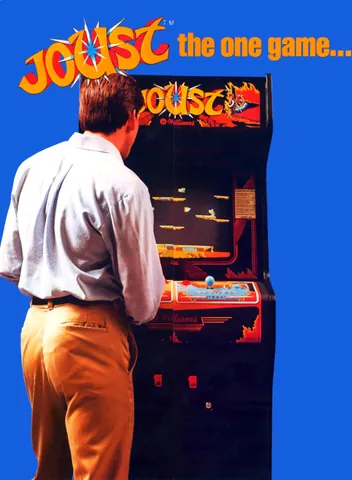
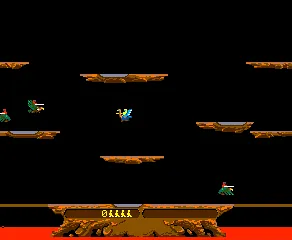
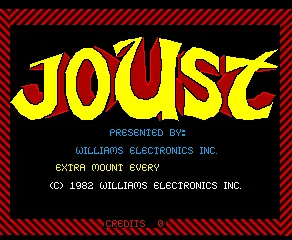
What if a knightly joust took place on the back of a flying ostrich? That's exactly the crazy premise behind Joust, which America's Williams Electronics brought to arcades in 1982 and which became one of the most original and social arcade games of its time.
The gameplay is built on unusual flight physics. The player controls a knight riding an ostrich (the second player rides a stork) and, instead of smooth movement, must constantly tap the flap button to stay airborne - the controls recall later games like Flappy Bird, only much earlier and far more sophisticated. Combat works on the principle of impact: whoever is positioned higher in the clash wins, and the opponent turns into an egg that must be collected before a new enemy hatches from it. This simple height-based mechanic gives the duels surprising tactical depth.
The most fundamental contribution of Joust, however, lies in its two-player cooperative mode. It's among the very first cabinets where two people could play simultaneously on the same screen - and the game brilliantly balances on the edge between cooperation and rivalry. Friends can help each other, but they can just as easily knock each other down and rob one another of points. This ambiguity sparked countless gaming friendships and arguments alike, and heralded an entire era of shared play.
Behind the game stood designer John Newcomer with the Williams Electronics team, in a period when the studio was churning out one inventive hit after another alongside Defender and Robotron. Joust became a commercially successful and critically acclaimed title, and to this day it stands as a textbook example of how original mechanics and clever multiplayer can create timeless entertainment.
Culturally, Joust earned itself a permanent place in the pantheon of the golden era. It was ported to a host of home systems, appears in practically every major retro compilation, and its flying ostriches have become one of the most recognizable icons in gaming history. The attempted sequel Joust 2: Survival of the Fittest never reached the fame of the original, but competitive players still recall that first installment to this day.
Why play: For the unmistakable flying physics and one of the best cooperative-competitive experiences of the golden era - knights on ostriches who still entertain after four decades.
Game 35 of 258 for Arcade
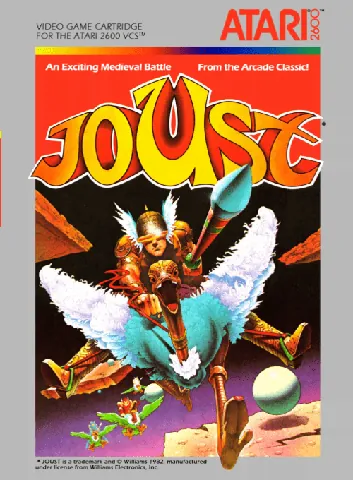
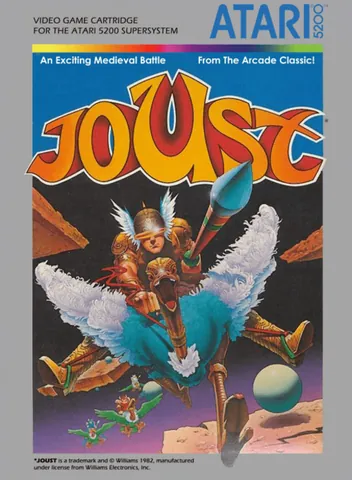
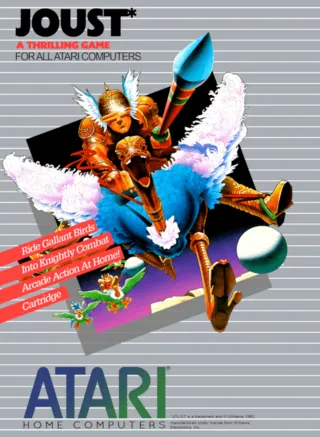
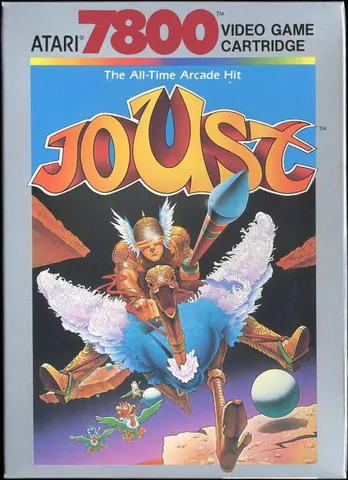
The same title elsewhere (4)
The arcade machine offered smooth animation of the flying ostriches and buzzards along with a vivid color palette that home consoles of the era tried to match with mixed success. The weaker Atari 2600 hardware forced blockier graphics, a more limited color range and simpler sound, which slowed the game down and drained some atmosphere compared to the arcade cabinet. The Atari 5200 ran on a more powerful chipset than the 2600, so its version offered smoother flight and more colorful surroundings closer to the arcade original. Anyone wanting Joust at its best should go for the arcade version, while those after a solid early-1980s home experience will prefer the Atari 5200 over the older 2600.