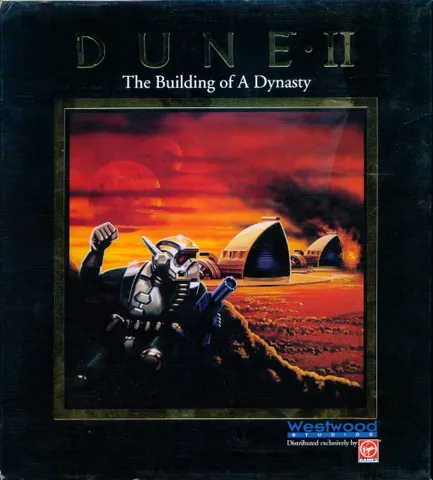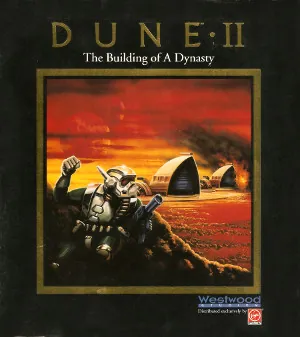
Dune II: The Building of a Dynasty
If there is a single game that can be called the birth certificate of the entire real-time strategy genre, it is Dune II: The Building of a Dynasty. What we take for granted today, resource harvesting, base building, a technology tree and commanding armies in real time, this game assembled together into a form that became the blueprint for decades to come.
The development was handled by Westwood Studios and it was released in 1992. Its setting in Frank Herbert's world was no accident: the player chooses one of three warring houses, the Atreides, the Harkonnen or the Ordos, and fights for dominance over the desert planet Arrakis and its most precious resource, spice. Harvesting spice from the sand, coveted by giant worms, gave the economic loop both tension and thematic depth.
The game mechanics that Dune II introduced sound today like a textbook of the genre. The player builds structures on concrete slabs, gradually unlocks stronger units, manages power and gathers the resource used to produce an army. Mouse control, unit selection and commanding them in real time were groundbreaking at the time and opened the way for games like Command & Conquer or Warcraft.
The cultural significance of Dune II is therefore hard to overstate. It laid the foundations of a commercially and culturally enormous genre, and Westwood built their reputation on it, along with the subsequent Command & Conquer series. On the Amiga the game benefited from colorful graphics and decent sound, though many players knew it mainly from the PC version.
Mechanics that we now take for granted had to be invented by someone first, and Dune II is exactly that pioneer. Without it, real-time strategy would look quite different, if it existed at all in its current form.
Why play: This is literally the forefather of real-time strategies, a mandatory stop for anyone who wants to understand where the genre came from.
Game 37 of 121 for Commodore Amiga