 Virtuality Group · 1991
Virtual reality
Virtuality
History & context
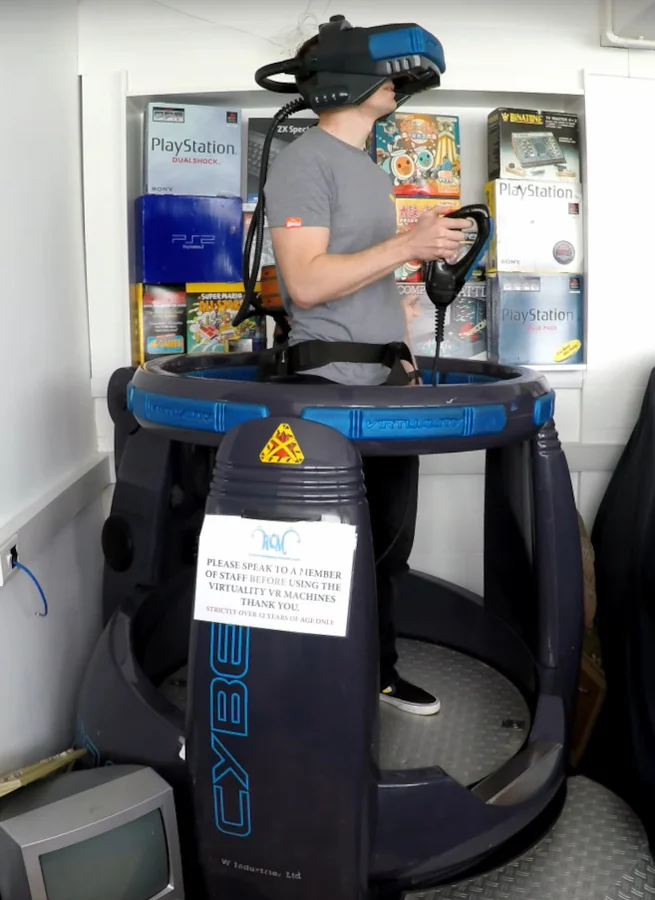
Before the phrase "virtual reality" became a marketing slogan of the nineties, there was one place where it could actually be tried out — an arcade with a circular platform and a player carrying a heavy helmet display on their head. That place was Virtuality, a system from the British company W Industries (later renamed Virtuality Group), launched in 1991. It was neither a home console nor a gaming computer, but an arcade attraction — an entire pod that a player stood or sat in and, for a few minutes, found themselves in another world.
There were two basic configurations. The 1000CS model was the standing version: the player stood on a circular platform bounded by a railing, since inside the headset they could see nothing of the surrounding arcade. The 1000SD model was the seated variant, suited to games where the player sat in a cockpit — typically flight simulators. On their head the player wore a headset with the fitting name Visette, and in their hands a controller shaped like a gun or a joystick, depending on the type of game.
For its time, it was a unique experience: real-time tracking of both head and hand movement, a stereoscopic image, and the possibility of several people playing against each other, linked into a single arena. In the end, it amounted to crude, blocky, textureless graphics — but in 1991, when people at home were playing on 8-bit and 16-bit consoles, a view into a three-dimensional world reacting to body movement felt like a miracle. It is exactly this combination that makes Virtuality one of the most iconic chapters of early VR development.
Technology: graphics and sound
In the first generation, the heart of the system was an Amiga 3000 computer, which rendered the scene for the headset in real time — an extremely demanding task for its time, since the image had to be computed separately for each eye while keeping the frame rate high enough that the player did not get sick. Later generations of the system switched to PCs with 486 processors, offering more computing power.
The graphical style was a direct consequence of these limitations: Virtuality's worlds were built from simple, flat-shaded, textureless polygons in a vivid but limited color palette. These were not photorealistic environments, but rather abstract geometric landscapes where shapes and the silhouette of the opposing player played the main role. Looking back it seems primitive, but combined with the stereoscopic headset and head tracking, it created an impression of real space, a total novelty at the time.
The audio side was secondary to the graphics — spatial sound merely added to the atmosphere, while the core of the technology lay in recalculating the world according to the player's movement in real time.
Connectivity and peripherals
The key peripheral was the Visette headset — by today's standards a heavy and unwieldy piece of equipment that delivered both the stereoscopic image and head-movement tracking. The player's hands held a controller whose shape varied by game: for action titles, a weapon resembling a pistol; for flight simulators, a joystick. This was precisely what set Virtuality apart from classic arcade cabinets — the player was not controlled by buttons alone, but turned, looked around, and aimed through physical movement.
Equally essential was the idea of networking several pods together. The system's most famous game, Dactyl Nightmare, was built exactly on this principle: two players, each in their own pod, fought on a set of floating platforms, while a flying pterodactyl interfered in the battle. It was one of the first networked multiplayer experiences in VR, and the title most often associated with the Virtuality name.
Models and variants
Virtuality was sold as a complete package — pod, headset, and controller — not as a home device. The basic division consisted of the 1000CS (standing) and 1000SD (seated) models, according to the type of game. The price of a single pod ran into the tens of thousands of pounds, which made it an investment exclusively for arcades, entertainment centers, and later amusement parks.
During the first half of the nineties, the system underwent hardware development, as the original Amiga-based solution was replaced by more powerful PC platforms with 486 processors. The visual language of flat, textureless polygons, however, remained a characteristic trait of the brand throughout its entire existence.
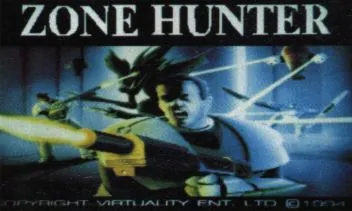
The game library was small but varied: alongside Dactyl Nightmare, it's worth mentioning Legend Quest (a fantasy adventure with sword and magic), Grid Busters (an action shooter), VTOL (a combat hovercraft flight simulator), and Zone Hunter (a cooperative space shooter). Each game lasted only a few minutes — however long an arcade visitor was willing to pay for a single session.
Clones and variants
Virtuality had no direct competition — it was the first commercially deployed public VR system in the world, which earned it a position that game industry historians still recall today. The idea of arcade virtual reality inspired other attempts in the entertainment industry of the nineties, as various companies tried to offer a similar experience through motion-based attractions, though none achieved comparable reach.
Unlike home consoles, then, there is no point looking for "clones" here in the traditional sense — this was not hardware that could easily be copied in a garage workshop. The barriers were the price, the complexity of motion tracking, and the space needed to install the pod.
Today's scene
Physical Virtuality units today rank among the rarest pieces of gaming history. They were large, expensive, service-intensive machines built for commercial operation, and the vast majority of them ended up scrapped once arcades moved on to newer attractions. Only a handful of functioning pods survive around the world, usually in private collections or museums.
Emulation in the classic sense — running the game at home on different hardware — does not quite make sense for Virtuality, because the experience was inseparably tied to the physical pod and to tracking the movement of the whole body. Even so, there are recordings of gameplay as well as fan attempts to reconstruct the atmosphere of the old titles in modern VR headsets.
The significance of Virtuality is thus primarily historical: it showed that the idea of immersive virtual reality with head and hand tracking works and entertains people, long before it became available for home use. When headsets like the Oculus Rift appeared two decades later, it was precisely this arcade era that was invoked as its spiritual predecessor — a blocky, imperfect, but unforgettable beginning of the genre.
Games on this platform (10)
No game in this genre.