 SEGA · 1994
Game consoles
SEGA 32X
History & context
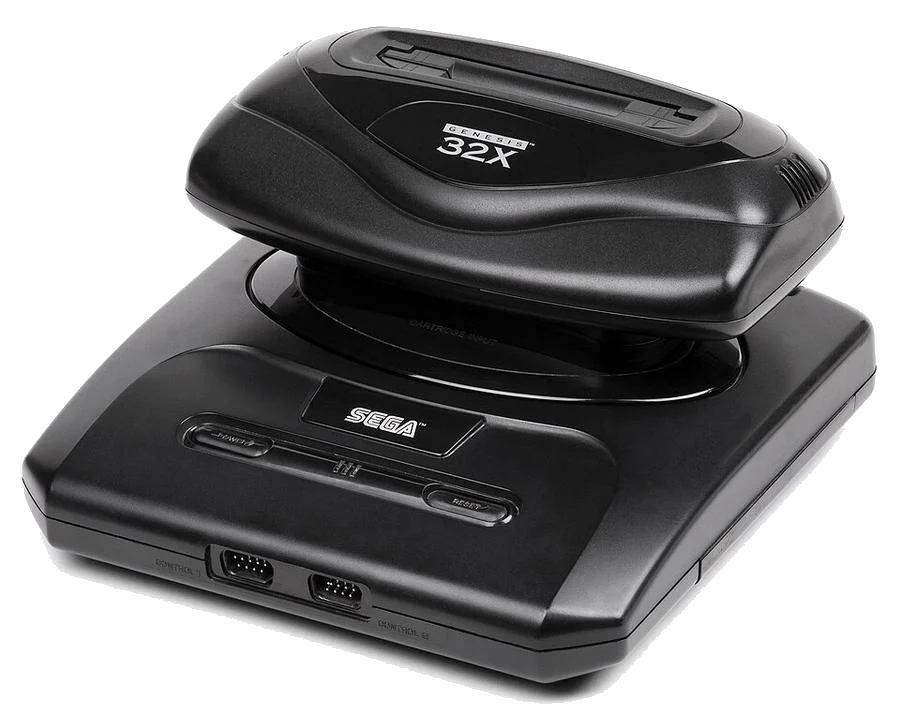
There are consoles that lost the battle for customers. And then there's the SEGA 32X — a device that lost the battle with its own company. In late 1994, Sega faced an uncomfortable realization: the 16-bit era was winding down, the competition was gearing up for 32 bits, and the Saturn wasn't yet ready for Western markets. The answer was supposed to be an add-on that would turn the existing Mega Drive into a cheap 32-bit console and bridge the gap until the real next generation arrived.
From the outside, it was a black "mushroom" mounted from above into the cartridge slot. Inside sat two 32-bit Hitachi SH-2 processors — the same chip family that powered the Saturn itself. The idea sounded logical: a Mega Drive owner wouldn't have to throw away their old console, just buy a box to go with it and suddenly have textured polygons on screen. But the Saturn showed up barely a year after the 32X, and the whole plan fell apart. Customers didn't understand what they were supposed to buy, developers didn't know where to invest their time, and stores had three incompatible Segas sitting side by side on the shelf.
The 32X's lifespan can be measured in months rather than years. Its library stopped at roughly forty games, and Sega quietly wrote the add-on off to shift all its energy to the Saturn. Today the 32X is a textbook example of how bad strategy can fragment even a very strong brand.
Technology: graphics and sound
The pair of Hitachi SH-2 chips ran at somewhere in the higher tens of megahertz, and at launch that represented decent computing power — especially for the 3D math that the contemporary Mega Drive, with its Motorola 68000, could only handle with enormous compromises. Importantly, the 32X doesn't replace the original hardware but supplements it: the 68000 and the eight-bit Zilog Z80 keep working, handling part of the logic and sound, while the SH-2 chips crunch the demanding stuff.
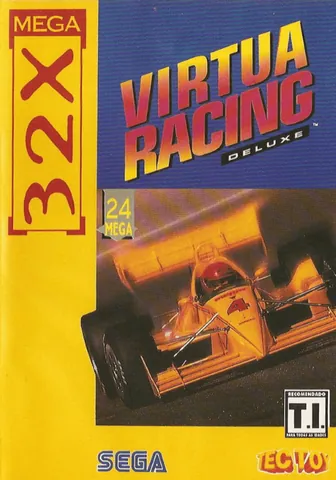
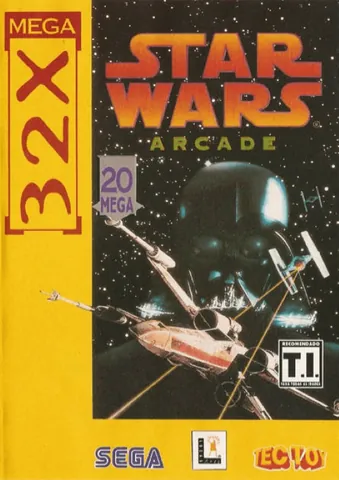
The add-on brought its own VDP and, crucially, a framebuffer, which let it push far richer color onto the screen than the Mega Drive alone — instead of a few dozen colors at once, it was on the order of thousands. The final picture is built by compositing layers: whatever the 32X draws blends with the image from the Mega Drive. That's exactly where the typical look of games like Virtua Racing Deluxe or Star Wars Arcade comes from — rough but smoothly rotating polygon objects over a background that still looks "sixteen-bit."
Sound got a boost from a PWM stereo channel, so the 32X can play higher-quality samples and digitized speech than the Yamaha YM2612 was capable of on its own. In practice, games usually mixed both.
Connectivity and peripherals
Installation was a chapter of its own. The add-on slid into the cartridge slot, needed its own power adapter, plus a short video link cable running from the Mega Drive's output to the 32X. Some console revisions shipped with plastic spacers to make the assembly sit properly. The result was a knot of cables and two outlets occupied by a single gaming system.
The crowning glory was combining it with the Mega-CD (Sega CD). Anyone who owned both ended up stacking the infamous tower of three devices: the CD drive on the bottom, the console on top of it, the 32X on top of that, plus three separate power supplies. Games that used everything at once could be counted on one hand, and they were mostly titles built around full-motion video. As an image summing up Sega's mid-1990s, though, that tower is unbeatable.
Controllers stayed unchanged — the standard three-button and six-button Mega Drive gamepads worked without a second thought.
Models and revisions
The 32X never got a major hardware revision — it simply wasn't on the market long enough. Across regions it launched under different names: Super 32X in Japan, Genesis 32X in North America, and Mega Drive 32X in Europe. After the failure, the price dropped steeply and the add-on lived out its days in clearance bins.
The most interesting model is the one that never shipped: the Neptune. Sega considered a single console that would integrate the Mega Drive and 32X in one housing, eliminating adapters, cables, and the tower altogether. The project died the moment it became clear that all attention had to go to the Saturn.
Clones and variants
The 32X barely saw any clones at all — unlike the Mega Drive, which dozens of manufacturers still produce today, the add-on was too complex, too specific, and too unsuccessful for anyone to bother imitating it. In Brazil, where Tectoy holds the Sega license, it did reach the market, but even there it didn't cause the kind of wave that the Mega Drive itself still commands.
What can be considered variants are really software categories instead: regular 32X cartridges and a handful of 32X CD titles that require the full setup with the Mega-CD. The second group is by far the hardest to find for collectors today.
The scene today
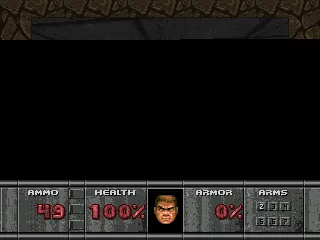
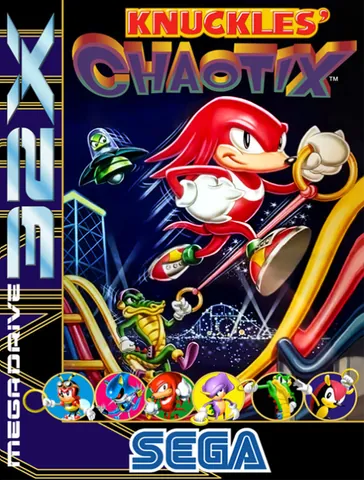
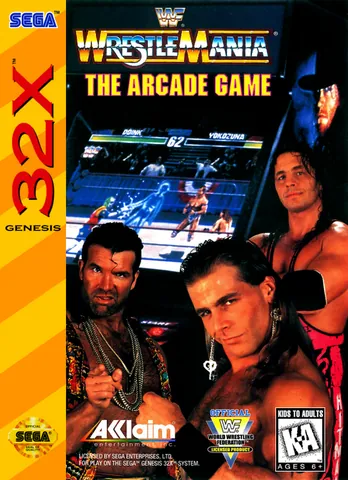
The 32X library is small, but a few names still stick in memory. Knuckles' Chaotix is the only platformer from the Sonic family on this hardware, known for its unconventional mechanic of two characters joined by an elastic tether. Virtua Racing Deluxe ranked among the best home conversions of its time, Star Wars Arcade delivered space-fighter combat, and Doom showed that the add-on could handle the era's phenomenon too — albeit a trimmed-down version.
Emulation is the main way to try the 32X today. The best support comes from the PicoDrive core, which runs in RetroArch and on distributions like Batocera and handles the 32X even on modest retro handhelds; on PC, the classic Kega Fusion has also proven reliable. Watch out for a common mix-up: the popular Genesis Plus GX covers the Mega Drive, Master System, and Game Gear, but does not emulate the 32X itself — for this system you need to reach for PicoDrive.
Legal re-releases are scarce, since Sega practically never recycles this part of its catalog; exceptions like Knuckles' Chaotix in the Sonic Gems Collection just prove the rule. What's left is the collector's market, where prices for both the add-on and rarer cartridges have been climbing steadily. Surprisingly, a community scene is alive too — the best-known example is the fan project Doom 32X Resurrection, which squeezed considerably more out of the original conversion than was possible back in 1994. Three decades on, the 32X mainly works as a curiosity and a cautionary tale: a technically interesting piece of hardware that lacked just one thing to justify its existence — time.
Games on this platform (15)
No game in this genre.