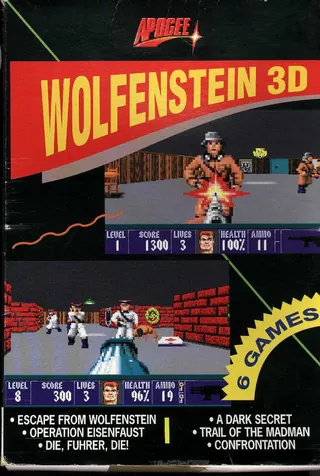
Wolfenstein 3D
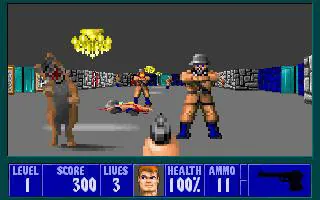
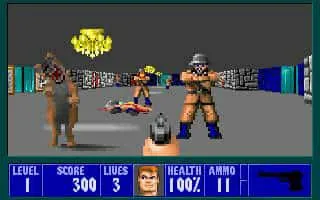
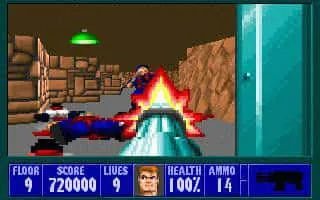
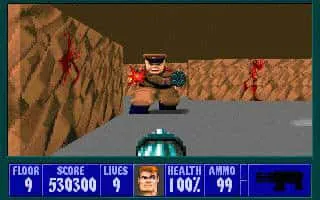
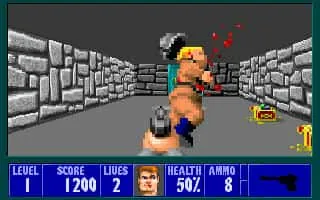
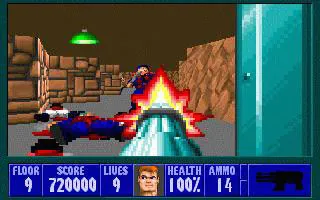
Wolfenstein 3D is the title that, in 1992, practically defined the shape of first-person shooters on PC. The player takes on the role of American agent B. J. Blazkowicz, who fights his way out of a cell in a Nazi fortress and steadily pushes deeper into the heart of the enemy empire. The structure remains a model of simplicity to this day: each floor is a maze of corridors, secret doors, and patrols, through which the player collects keys, ammo, gold treasure, and medkits in order to finally reach the elevator to the next level. There are no scripted sequences or branching quests, just the pure rhythm of opening doors, shooting, and feeling along walls in search of hidden stashes.
Technically, it was a revelation. The chosen method of rendering space allowed textured walls to move smoothly and quickly on the computers of the time, something the competition couldn't match for a long while. Viewed today, the execution feels archaic — aiming is purely horizontal, all walls are perpendicular, and each floor sits on a single flat plane — yet it's exactly this economy that kept the pace up. Digitized guard screams, barking dogs, and an energetic soundtrack courtesy of Ad Lib and Sound Blaster cards gave the game a raw, comic-book-exaggerated aggression that etched itself into memory just as strongly as the visuals.
The game spread through the shareware model, with the first episode circulating freely while the rest was ordered separately, which opened its way onto BBSes, floppy disk collections, and school computers around the world. It sparked the first great wave of imitators, and for years the whole genre measured itself against it. Today Wolfenstein 3D plays surprisingly briskly: the levels are short, the pace is fast, and hunting for secret walls still has its charm, even if navigating the repetitive corridors can grow tiring. Its main value, though, lies in the experience itself — you get to feel firsthand the moment PC games first properly stepped into three-dimensional space. It helps that the game never tries to be anything other than what it is. Anyone wanting to understand why an entire branch of the games industry headed in this direction should play through the whole first episode.
Game 16 of 204 for PC / DOS (XT až 486)
The same title elsewhere (2)
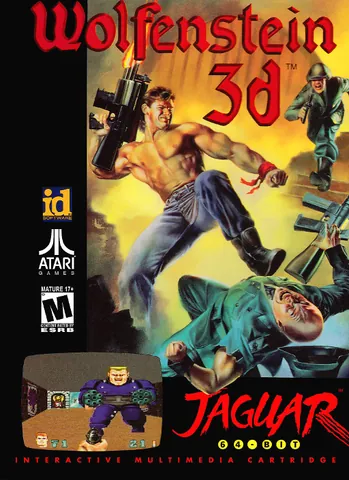
The 1992 PC version ran under DOS and could fully exploit keyboard, mouse and sound cards like AdLib or Sound Blaster, giving it smooth controls and richer music and effects depending on the machine's hardware. The Atari Jaguar port was one of the most technically impressive console conversions of its time: thanks to the powerful 64-bit hardware it ran briskly and came visually very close to the PC original, though it was controlled with a gamepad instead of keyboard and mouse, which changed the feel of aiming and movement. The Jaguar version also arrived a year later and had to work within the console's constraints, so it diverges from the PC original in some details. Anyone wanting the experience closest to the original with precise mouse aiming should pick the PC; anyone wanting console comfort with solid technical performance will find one of the best ports on the Jaguar.

From the same series Wolfenstein →
 Wolfenstein: The New Order PS3 · PS4 · XONE · PC
 Wolfenstein II: The New Colossus PC · PS4 · XONE · Switch
 Wolfenstein 3D GBA · 2002
 Return to Castle Wolfenstein: Tides of War Xbox · 2003 Mobil Wolfenstein RPG Mobil · 2008
 Wolfenstein X360 · PS3 · PC · 2009
 Wolfenstein: Youngblood PC · 2019
 Wolfenstein: Cyberpilot PCVR · 2019