Operation Wolf
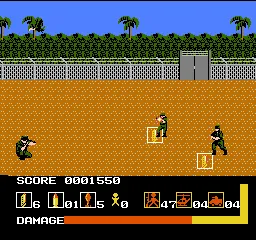
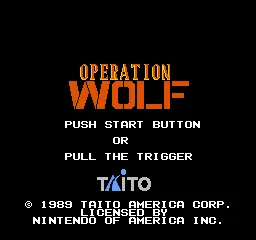
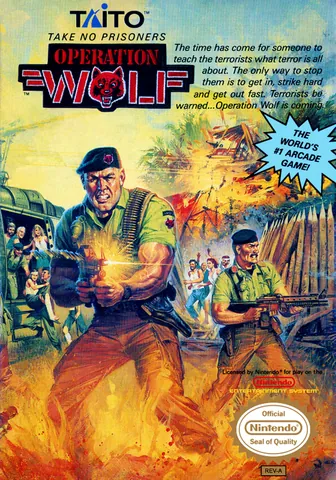
You step into the jungle, aim at the screen, and the world around you turns into a continuous barrage. Operation Wolf on the Nintendo NES is the home makeover of one of the most legendary arcade hits of the eighties, and even in its living-room form it keeps its raw, adrenaline-fueled DNA: you are a lone commando who must fight through a series of missions, free hostages and gradually smash an enemy operation across confusing terrain.
At the game's core is continuous horizontal scrolling, where the image slides on its own and you aim at targets with a movable cursor. On the NES, aiming was handled either by the classic controller combination or by the Zapper light gun, which was what really gave the game its true arcade stamp. The mechanic is brilliantly simple yet merciless: enemies dash out of the undergrowth, throw grenades, vehicles and helicopters roll in, and you must decide in a fraction of a second whom to take down first. Ammunition and lives are not infinite, so every shot carries weight and panic is your greatest enemy.
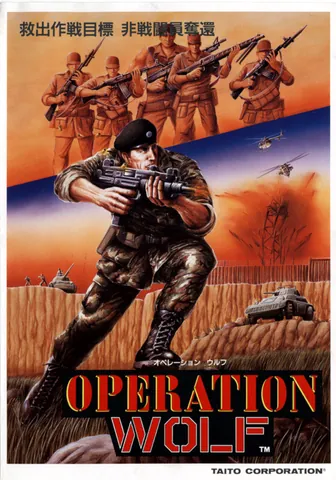
The original arcade machine from Taito, released in 1987, was groundbreaking above all for its controls. Built into the cabinet was a so-called positional gun styled as an Uzi submachine gun, which did not respond to light like ordinary light-gun pistols but instead sensed the position of the barrel. That allowed continuous fire and the feeling that you were really hosing the screen with bursts. This detail made Operation Wolf an instant sensation in arcades and defined an entire subgenre of arcade shooters, later followed by games such as Cabal, Beast Busters and the later rail shooters.
The home conversions, meanwhile, were enormous, and the NES version was among the more important ones because it brought the arcade experience into living rooms. Operation Wolf received ports to a whole array of systems of its time, from the ZX Spectrum, Commodore 64 and Amiga computers to the PC Engine. It was precisely this ubiquity that made the title one of the best-known symbols of the militaristic action of the late eighties, when pop culture lived on films like Rambo — and Operation Wolf rode that wave perfectly.
The game's cultural footprint is unmistakable today. Operation Wolf is regularly cited as one of the milestones of the light-gun genre and as a title that showed intense, cinematic action can work even in a simple arcade form. For many players it was their first contact with shooting at the screen, and the memory of the Uzi's rattle and the enemies dashing out is etched into memory to this day.
On the NES the game had its specifics dictated by the console's hardware. The creators had to squeeze arcade action into the more modest capabilities of the eight-bit Nintendo, so the NES version comes across as somewhat more intimate than the blazing cabinet from the arcade. Even so, it kept its drive toward the goal, and in combination with the Zapper it offered home audiences something they had until then known only from arcades: real gun-aiming at the television screen. It was precisely this accessibility of the console conversion that formed an important piece of the puzzle, thanks to which Operation Wolf reached players who never made it to the arcade machine.
Why play it: For the raw, uncompromising adrenaline of eighties action and for the nostalgia of the days when all you needed was a gun, a screen and steady nerves.
Game 43 of 120 for Nintendo NES
The same title elsewhere (3)
In the arcade, Operation Wolf put a real machine gun bolted to the cabinet in your hands, one you could tilt and swivel, and the game answered with brisk, fluid graphics and plenty of enemies on screen. The home Nintendo NES version, played with a standard pad or the optional Zapper light gun, had to cut enemy counts, simplify backgrounds, and dial back colors and speed due to weaker hardware. Even so, it kept the core adrenaline of the jungle shooting-gallery feel. For the full experience with a real machine gun in hand, the arcade is the one; the NES offers a simplified but still playable home take.