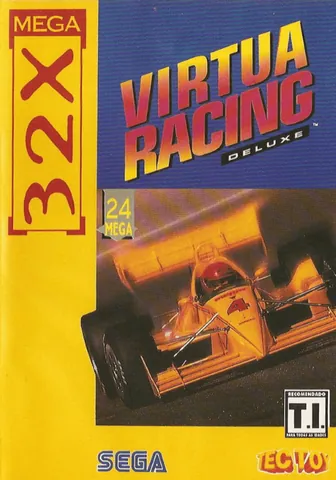
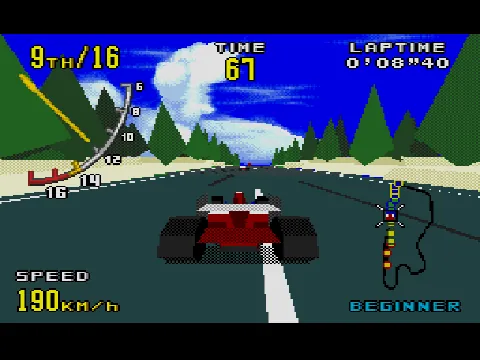
When the home version of Virtua Racing appeared on the SEGA Mega Drive in the mid-nineties, it looked like a technical miracle. Fully polygonal 3D racing on a sixteen-bit console, which in theory should not have had such power within its reach. SEGA pulled it off thanks to a special chip built directly into the cartridge.
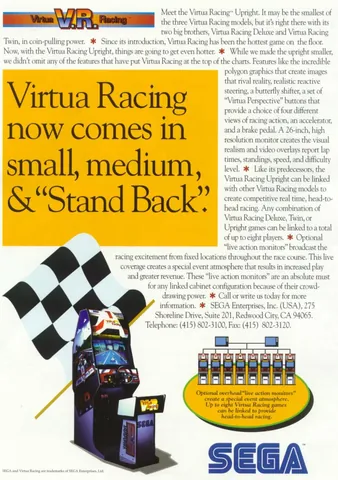
Originally it was an arcade machine from 1992, one of the first titles built on the SEGA Model 1 hardware and a milestone in the history of 3D games. Virtua Racing showed what racing made of full polygons looked like, with the ability to switch cameras between a view from behind the car and external angles. This camera-switching system later became a standard of the entire genre.
The home conversion for the Mega Drive used a chip called the SVP, housed in the game module itself. This made the cartridge one of the most expensive and technically advanced ever released for the console. For Mega Drive owners it was the pride of the collection and proof that their console could do things the competition could only dream of.
In terms of gameplay it is pure arcade. You pick from several tracks of varying difficulty, race against opponents and the clock, and learn the ideal line through the corners. The sense of speed and the then-futuristic smoothness of the polygonal graphics made every lap an experience, even if the geometry looks angular to today's eye.
Virtua Racing stood at the beginning of the famous era of SEGA AM2 and director Yu Suzuki, which later gave rise to titles like Virtua Fighter and Daytona USA. As one of the first successful polygonal arcade machines, it played an important role in the whole industry's transition from sprites to full 3D.
Today the home version for the Mega Drive is a prized rarity and a technological curiosity. It recalls a time when the boundaries of hardware were pushed by special chips right inside the games, and when the mere sight of smooth polygons could take your breath away.
Why play it: For a historic milestone of 3D racing and an admirable technical feat — getting full polygons onto a sixteen-bit console.
Game 97 of 151 for SEGA Mega Drive