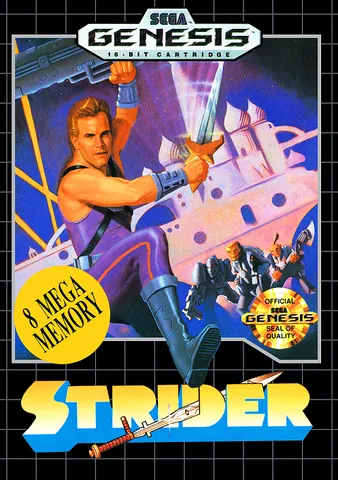
Strider
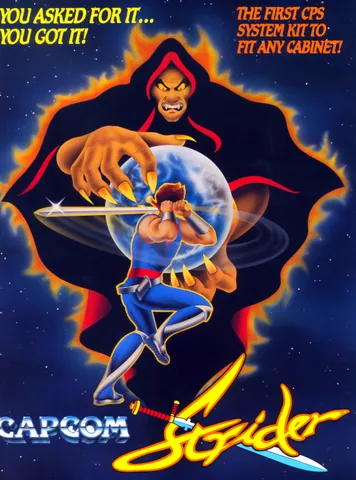
Some games are ahead of their time, and Strider is one of them. This action title starring the cybernetic ninja Strider Hiryu dazzled players in the arcades, and its home conversion for the Mega Drive became one of the technical and experiential peaks of the console's early era. Its speed, fluidity, and almost cinematic grandeur made it a game SEGA owners proudly showed off as proof of their machine's power.
Mechanically it is a fast-paced action platformer in which Hiryu slices through ranks of enemies with his plasma blade, climbs walls and ceilings, jumps and slides across slopes with an elegance that had no equal. The pace is relentless, the enemies numerous, and the boss battles spectacular. The game demands quick reflexes and a feel for fluid movement, but rewards you with a sense of total action freedom.
The original arcade version comes from Capcom in the late eighties, and its story sends the hero into a hostile, futuristic version of the world where he faces a powerful organization. The visual style mixed sci-fi with exotic motifs and grand set pieces that felt extraordinarily ambitious by the standards of the day. The Mega Drive conversion managed to preserve this sweep surprisingly faithfully.
Culturally, Strider went down as a genre icon, and the character of Hiryu became a respected fighter who later appeared in other games and crossover fighters as well. The game inspired imitators and became a benchmark for how fast, stylish action with an emphasis on movement and spectacle should look.
Today Strider is a reminder of an era when a conversion from the arcade to a home console was a major event and when SEGA was proving that its hardware could deliver the arcade experience straight into the living room. It is still an adrenaline-fueled, visually striking ride.
Why play it: For fast, stylish action with an incredibly nimble hero and grand spectacle that felt like it came from the future.
Game 83 of 151 for SEGA Mega Drive
The same title elsewhere (1)
The Capcom CPS arcade original ran on hardware built for smooth sprite scaling and rotation that no home system of the era could fully match. The SEGA Mega Drive conversion is still counted among the most admired home ports of its time — it keeps the arcade's speed, feel, and controls remarkably close to the source, even though backgrounds are less detailed and some visual effects were simplified. The Mega Drive's three-button pad handles the action reliably, if without the precision of an arcade joystick. For the purest experience, seek out the arcade version; for a couch experience without coins, the Mega Drive conversion remains one of the best period substitutes.