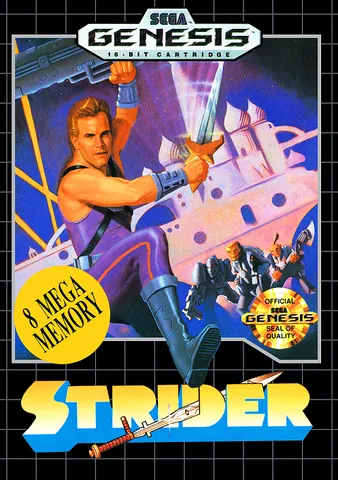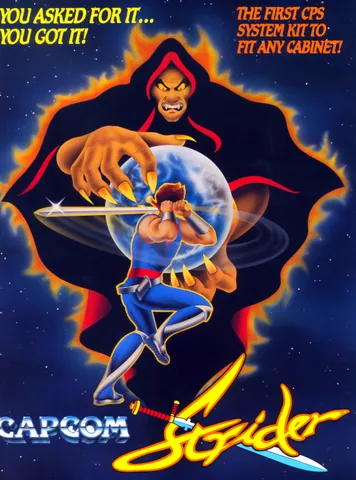
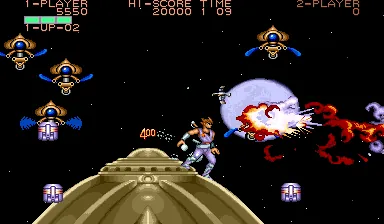
The ninja Hiryu leaps from a flying wing straight into a snow-covered Kazakhstan, his plasma katana flashes and within a second the fight turns into a ballet of movement. Strider was a revelation in the year of its release – an action platformer that felt faster, smoother and more cinematic than anything around it.
The game was created at Capcom on the CP System board as a lavishly conceived arcade project, tied at the same time to a manga. Hiryu is an elite agent of the Strider organisation and his mission takes him across a futuristic Soviet Union all the way to the mysterious ruler Grandmaster. His main weapon is the Cypher, an energy sword whose whistling slashes became the trademark of the series.
What enchanted with Strider was the movement. Hiryu climbs walls, swings across ceilings, slides down slopes and clambers practically anywhere, which turned the levels into an acrobatic playground. Added to this were inventive bosses – a giant snake made of robotic technicians or a gigantic gorilla – and exotic settings from Siberia through the Amazon jungle to a space station. The visual sweep and pace were extraordinary for their time.
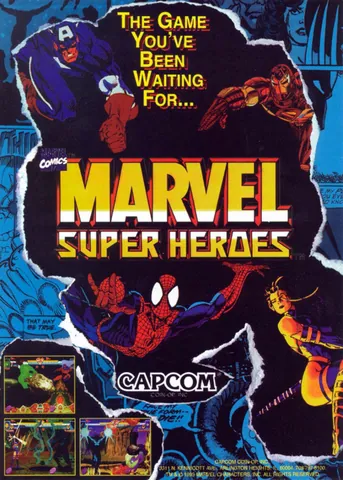
Culturally Strider is remembered as one of the defining arcade action games of the turn of the eighties and nineties. The character of Hiryu later became a Capcom fixture and appeared as a playable fighter in the Marvel vs. Capcom series, where his fast combos and the Cypher fitted in perfectly. This kept Strider popular even with players who never played the original arcade version.
The game received conversions to home systems such as the Mega Drive or Amiga-line computers, and later even a more modern reboot. Even so, the arcade version still holds a special charm thanks to its pace and atmosphere. Strider remains a textbook example of how to make an action game that both looks and plays like a comic book in motion.
Why play it: For brisk, acrobatic action with an unmistakable style and one of the coolest gaming characters of its era.
Game 2 of 29 for Capcom CPS
The same title elsewhere (1)
The Capcom CPS arcade original ran on hardware built for smooth sprite scaling and rotation that no home system of the era could fully match. The SEGA Mega Drive conversion is still counted among the most admired home ports of its time — it keeps the arcade's speed, feel, and controls remarkably close to the source, even though backgrounds are less detailed and some visual effects were simplified. The Mega Drive's three-button pad handles the action reliably, if without the precision of an arcade joystick. For the purest experience, seek out the arcade version; for a couch experience without coins, the Mega Drive conversion remains one of the best period substitutes.