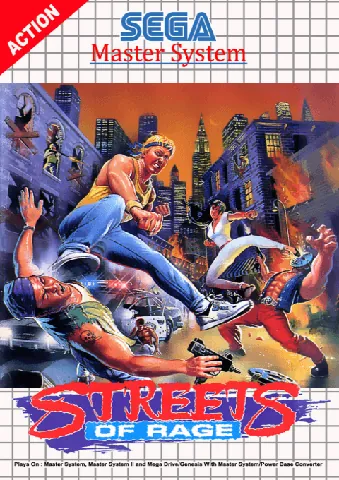
Streets of Rage
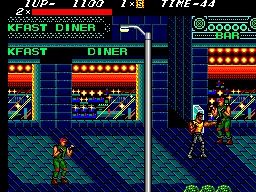
Streets of Rage arrived on the Master System as a simplified but surprisingly faithful adaptation of the successful beat-'em-up from the 16-bit Mega Drive. The player walks the streets of a corrupt city as a former police officer who has decided to take justice into his own hands, clearing out waves of street gangs along the way using punches, kicks, throws, thrown weapons, and the occasional radio call-in for backup, which can only be used a limited number of times per game and briefly clears the screen of enemies.
Due to the limitations of 8-bit hardware, the number of enemies on screen had to be reduced, along with simplified backgrounds and shorter individual levels, yet the port retains the genre's basic rhythm as well as simultaneous two-player mode, which was by no means a given for ports from more powerful consoles at the time and which set the game apart from many other 8-bit titles of the era. The music draws on themes from the original synthesizer soundtrack and, even in its 8-bit arrangement, retains part of its energetic atmosphere, which together with the colorful graphics and smooth character animation makes the port a visually and sonically respectable version of the famous original, though naturally more modest than the Mega Drive version.
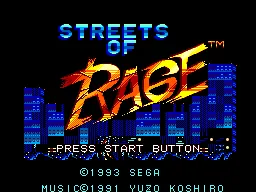
The game's 1993 release shows just how long the Master System remained commercially alive outside Japan and North America, especially in Europe and Brazil, where the console retained a loyal audience even after the arrival of the newer console generation, and where local publishers kept supporting the platform for years afterward. For genre fans, it remains an interesting demonstration today of how much of the 16-bit hit's action could be transferred to older hardware without the result feeling like a hopelessly impoverished substitute for the famous original, and it's worth trying even as a standalone, compact experience for short co-op sessions between two players on the same couch.
Why play: For beat-'em-up fans curious how much of the 16-bit hit's action fit onto older hardware, and for short two-player co-op sessions on the same couch.
Game 42 of 67 for SEGA Master System
The same title elsewhere (2)
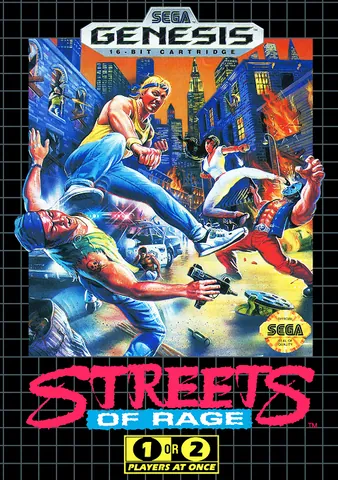
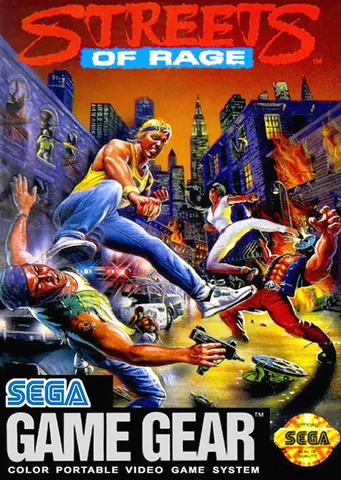
The 1991 SEGA Mega Drive version is built on Yuzo Koshiro's iconic music, fully exploited by the console's FM synthesis, and offers two-player co-op. The portable SEGA Game Gear version, due to its smaller screen and weaker hardware, had to cut down the number of enemies on screen and the quality of the music, and reduced the game to single-player only. The graphics are logically simpler and less colorful, matching what the handheld could manage. The Mega Drive version therefore remains the main, most valued form of the game, while the Game Gear offers more of a lightweight version for the road.