Alex Kidd: The Lost Stars
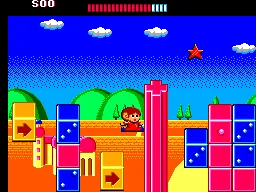
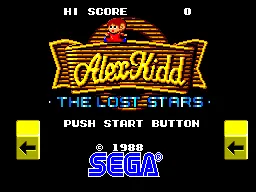
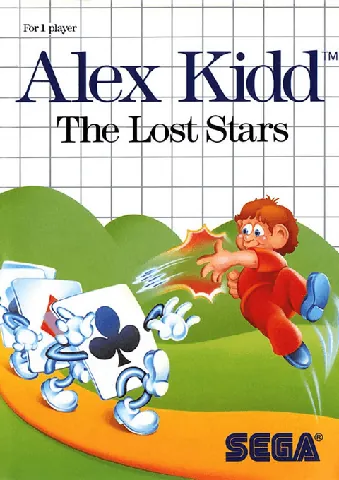
Alex Kidd: The Lost Stars is the very first appearance of Sega's mascot, predating the more famous Miracle World. It's a more straightforward arcade platformer in which Alex fights his way through a series of short levels to collect scattered stars and ultimately rescue his fiancée, kidnapped by an evil adversary. The gameplay is built on jumps, punches, and kicks, complemented by power-ups that change Alex's abilities and temporarily grant faster movement or stronger attacks, and its structure resembles a sequence of arcade-style challenges rather than a continuous, interconnected adventure with a unified open world — more a series of standalone challenges with no need to return to previously visited places.
Compared to the later Miracle World, the game feels simpler and more direct – the levels are shorter, enemies repeat, and the emphasis is on quick reflexes rather than exploration or the puzzle-solving that later entries became known for. Both the sound and graphics reflect the Master System's early phase, so visually the game doesn't reach the quality of the console's later titles, yet it has its own distinctive colorful, cartoonish style with cute enemies and simple, legible backdrops, which became a hallmark of the whole series even in later, more elaborate sequels.
Historically, the game is interesting mainly because it laid the foundation for a character who, for several years, became the unofficial face of Sega in the platformer field, before that role was taken over a few years later by Sonic the Hedgehog and his significantly faster, more action-oriented take on the genre. For today's player, it offers more of an archaeological look at the beginnings of the Alex Kidd brand than a gameplay experience that would fully hold up next to the series' later, more elaborate entries, but as a historical curiosity and the famous mascot's first step, it holds a firm place in the history of the Master System and the entire Sega brand, and fans of the 8-bit era should at least know about it.
Why play: For fans of Sega's history and the beginnings of the Alex Kidd mascot who don't mind more archaic gameplay compared to the series' later, more elaborate entries.
Game 40 of 67 for SEGA Master System