Vermin
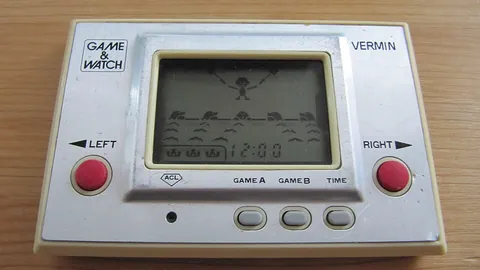
Imagine a time when a portable gaming marvel was as big as a pocket calculator, ran on a button battery, and could still swallow up entire breaks at school. This is exactly the world Vermin belongs to, one of the titles from Nintendo's legendary Game & Watch line. No color display, no polygons, just a segmented LCD panel on which pre-drawn images appear and disappear. And yet it worked.
Vermin builds on a simple but relentless premise. The player controls a character with a hammer (in period materials a gardener defending his flower bed) and tries to hit the small pests crawling out of holes in the ground. Moles or worms appear alternately on two sides of the screen, and you have to shift your gaze and your hammer in time to drive them back before they manage to do damage. The principle is purely reflexive: the longer you play, the faster the enemies appear, and mistakes add up to three "misses".
Game & Watch was a series of handheld electronic games that Nintendo began releasing in the early 1980s. Behind it stood the work of inventor Gunpei Yokoi, who later also co-created the Game Boy and the cross-shaped D-pad controller. Game & Watch were a commercial springboard for Nintendo long before the famous Famicom arrived, and their simple yet cleverly designed mechanics defined an entire category of LCD games that was then imitated by dozens of manufacturers.
Vermin belongs to the very earliest wave of the Silver series models, that is, the silver single-screen devices with a built-in digital clock and alarm. That also explains the name "Game & Watch": besides the game, the device served as a real watch. This dual function was a huge part of the charm, because you could carry the game anywhere like an ordinary gadget.
The cultural significance of these games is clearly evident today. Game & Watch laid the foundations of portable gaming, which the Game Boy built upon, and their segmented LCD aesthetic became iconic. Mechanics such as switching between two positions and an escalating pace appear in emulations, collector's collections, and in modern homages. Specific details like exact sales figures or rankings for individual titles in the line are often not reliably documented, so it is better to stick to what is verifiable: it was a pioneering, massively popular format.
Vermin is more of a museum piece today, but still surprisingly addictive. It is a demonstration of how tension and a reflex challenge can be squeezed out of utterly minimalist means.
Why play: For a nostalgic taste of the dawn of portable gaming and for pure, instantly understandable reflex fun in the most economical possible form.
Game 15 of 17 for Nintendo Game & Watch