Kuru Kuru Kururin
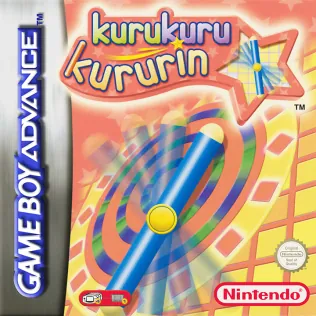
Kuru Kuru Kururin was among the Game Boy Advance's launch titles, and even years later it stands as proof of how a pure idea can carry an entire game without a single unnecessary extra element. You control a rotating rod that moves smoothly through the winding corridors of a maze, and the only thing the player actually controls is the speed and direction of its rotation using the L and R buttons. The rod must not touch the walls, and the narrower, more winding, or more crowded with moving obstacles a corridor is, the greater the demands it places on the player's sense of timing, patience, and spatial awareness. Moving obstacles and narrow bottlenecks the rod must slip through with almost no margin for error gradually appear as well.
Technically it's an unassuming but precisely tuned game — bright colors, clear graphics, and perfectly smooth movement made Kuru Kuru Kururin an ideal showcase of what a new handheld with a color backlit screen could offer. The music is light, cheerful, and complements the pastel, playful visual style well, with themed worlds ranging from forests through underwater caves to factory halls full of machinery. The game also offers competitive and time-attack modes that stretch the simple core principle across dozens of levels with gradually rising difficulty, forcing the player to refine their control technique again and again, while progressing through the worlds unlocks new visual motifs and types of obstacles, so despite its simple foundation the game never feels repetitive.
At launch the game was appreciated mainly by players looking for something other than the action platformers and RPGs that flooded the GBA catalog in its early years — Kuru Kuru Kururin was, by contrast, meditative, precise, and utterly uncompromising about any mistake. It was never released in North America, which made it a semi-hidden gem that had to find its way to players there through imports and fan recommendations. To this day it is cited as an example of elegant game design built around a single mechanic taken to absolute perfection, and its legacy lives on in similarly minimalist "one mechanic, endless fun" titles that later appeared on mobile devices and digital storefronts.
Game 136 of 170 for Game Boy Advance