M.U.L.E.
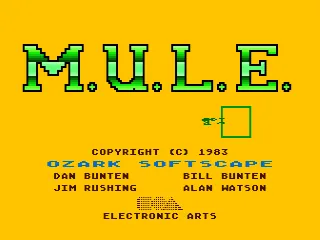
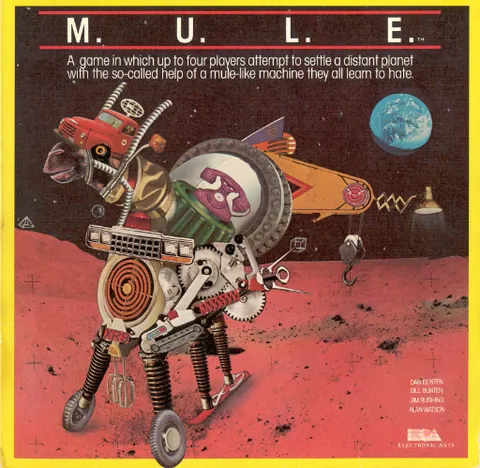
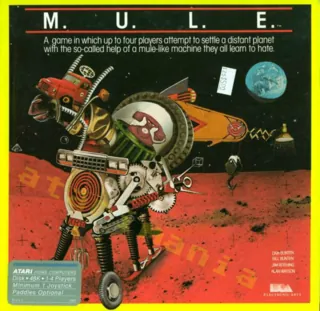
Imagine a board game about colonizing an alien planet that pushes you to betray your best friend over a bag of ore — while making you laugh out loud in the process. That's M.U.L.E., a title that came out in 1983 for the Atari 8-bit and is still cited in expert circles as one of the best-designed game systems ever.
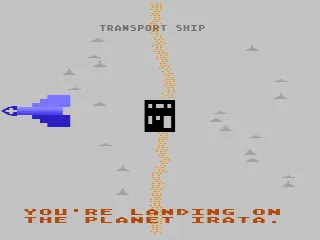
Four players (human and computer) arrive on the planet Irata, where they divide up plots of land, hire robots called M.U.L.E.s, and produce four key commodities: food, energy, smithore ore, and rare crystite. The whole game rests on a brilliantly tuned economy of supply and demand. As soon as someone runs out of energy, the others can drive the price sky-high — or help them out, because if the entire colony goes bust, nobody wins. This tension between selfishness and shared interest makes M.U.L.E. an unexpectedly social experience.
Behind the game stand the studio Ozark Softscape and above all Dani Bunten, one of the most respected figures of early game design. It was released under the banner of Electronic Arts in their legendary first wave of titles, when EA presented game creators as rock stars on boxes resembling music albums. M.U.L.E. ranks among the pioneers of single-screen multiplayer as well as of economic simulations as a genre.
The mechanics look simple on the surface but hide surprising depth. Auctions play out in real time, with players moving their characters up and down according to the price they're willing to accept. Random events, market fluctuations, and small acts of sabotage keep every match unpredictable. The balancing of the individual commodities is so precise that developers and academics still study the game today.
Although M.U.L.E. never became a mass commercial hit, its influence is unmistakable — creators from Sid Meier to modern indie designers cite it. Dani Bunten is repeatedly ranked among the most influential authors in the history of the medium, and M.U.L.E. is often called her masterpiece.
Why play: For one of the purest examples of brilliant game design — an economic strategy that's best with four players and, after forty years, still hasn't lost any of its charm.
Game 2 of 124 for Atari 800 / 8-bit
The same title elsewhere (1)
M.U.L.E. was created on Atari's 8-bit home computers, which had built-in support for up to four joysticks at once, letting all four players sit at a single machine each with their own stick. The Commodore 64 has only two physical joystick ports, so its port had to handle the third and fourth player through the keyboard, making it somewhat less comfortable when playing with a full table. On the other hand, the C64 benefits from its SID sound chip, which gives the music and sound effects a fuller, richer sound than Atari's POKEY chip. Content and visuals are very close between the two versions, so the choice mainly comes down to more comfortable four-player control versus richer sound.