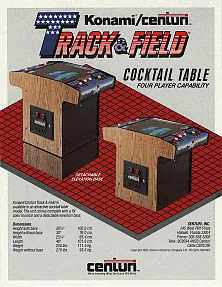
Track & Field
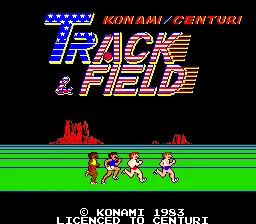
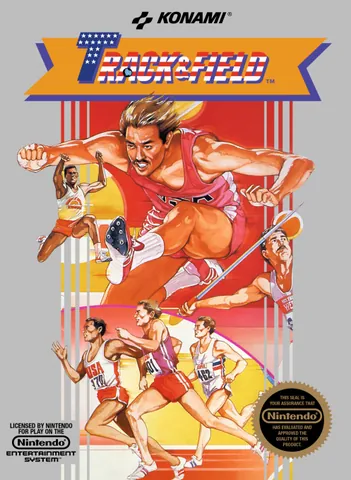
Sweaty palms, aching fingers and buttons that nearly throw off sparks. Track & Field is an arcade machine that in 1983 turned button-mashing into an Olympic discipline. Konami created here one of the defining sports machines of the eighties and a template for the entire genre of athletics games.
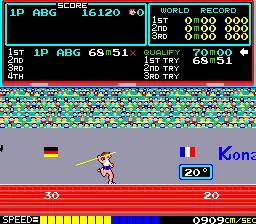
The principle is brilliantly simple and at the same time devilishly exhausting. You mash two running buttons as fast as possible to build up speed, and with a third button you control the angle of a jump or throw. Disciplines like the hundred-meter sprint, long jump, javelin throw, hurdles and pole vault each require slightly different timing and a frenetic finger pace. The requirement to meet a qualifying limit makes every attempt tense.
Track & Field became famous precisely for that insane button-mashing, which drove more than one player to using a ruler, a coin or other tricks for faster oscillation. That physical intensity was part of the magic and pulled crowds into the arcades. The battle for the highest score on the leaderboard was a purely social experience.
The machine's success led to a range of ports to home computers and consoles, including versions for the NES, where the game lived on under various names tied to Olympic themes. Konami built on the formula with further sports titles and Track & Field became a model that plenty of followers imitated.
Culturally it was one of the first big multi-event sports titles and proof that controls built on just a couple of buttons could evoke enormous intensity. The game was a mainstay of the arcades and its rapid-mashing mechanic entered the vocabulary of a whole era.
To this day Track & Field is synonymous with classic arcade competitiveness. It is pure, instantly comprehensible fun about one thing only: being faster and more precise than the others. And in that very simplicity lies its immortality.
Why play: For immortal arcade competitiveness and frenetic button-mashing that turned athletics into a race for the highest score.
Game 66 of 258 for Arcade
The same title elsewhere (1)
The 1983 arcade original ran on dedicated Konami hardware and excelled with smoother running animation and richer sound, plus buttons built specifically to survive rapid alternating mashing. The Nintendo NES conversion had to cut back on the color palette and simplify background graphics, yet it kept the core mechanic intact – frantic button mashing for the sprint, long jump or javelin throw. Controls on a standard NES pad feel less satisfying than the arcade's heavy-duty buttons, but the game remains just as addictive a test of fingers and patience. The arcade original is generally considered the most authentic way to play it, while the NES version is a solid home alternative for anyone without access to the cabinet.