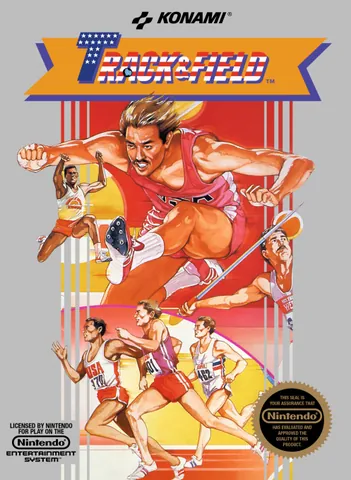
Track & Field
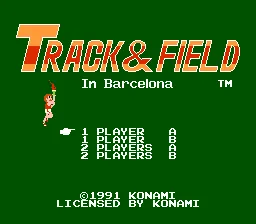
Battered buttons, sore fingers and a neighbour who insists that this time you will pull it off. Track & Field is the definition of a game where not only the pixel athletes on the screen sweat, but you at the controller too. Konami brought its arcade hit from the 1980s to the NES, and with it a whole genre of athletics button-mashers that ruled arcades around the world at the time.
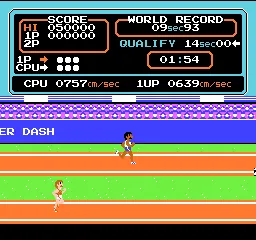
The principle is ingeniously simple and at the same time brutally addictive. Events such as the sprint, long jump, throw or pole vault rest on frantic button-mashing, which gets your athlete up to speed, and on precise timing, which triggers the take-off or throw. The faster and more persistently you pound, the better. Your competitiveness and the physical stamina of your fingers become the main gameplay mechanic here. It is simple to grasp, but mastery requires hours of training.
The magic of Track & Field lies in the chase for records and in beating the qualifying limits. Every event has its threshold you have to overcome to advance further, and every hundredth of a second counts. The game thus superbly feeds that simple human desire to be a fraction better than last time, and above all better than the friend sitting next to you.
It is precisely in multiplayer that the game turns into a genuine tournament. Taking turns at the controller, cheering, jubilation over a new record and the angry tossing of the gamepad after a narrow loss. Track & Field captured the spirit of Olympic competition and transferred it into the living room in a way that still works to this day. No complicated rules, just pure speed and reflexes.
With this title, Konami long defined the shape of sports arcades and inspired countless other games of the same cut. Track & Field is today seen as one of the cornerstones of the genre, one that everyone returns to who wants to test just how fast they can still mash. It is a retro classic in its purest form.
Why play: For adrenaline-fuelled button-mashing and a contest for records that will get any party at a retro console going.
Game 71 of 120 for Nintendo NES
The same title elsewhere (1)
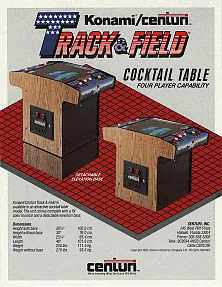
The 1983 arcade original ran on dedicated Konami hardware and excelled with smoother running animation and richer sound, plus buttons built specifically to survive rapid alternating mashing. The Nintendo NES conversion had to cut back on the color palette and simplify background graphics, yet it kept the core mechanic intact – frantic button mashing for the sprint, long jump or javelin throw. Controls on a standard NES pad feel less satisfying than the arcade's heavy-duty buttons, but the game remains just as addictive a test of fingers and patience. The arcade original is generally considered the most authentic way to play it, while the NES version is a solid home alternative for anyone without access to the cabinet.