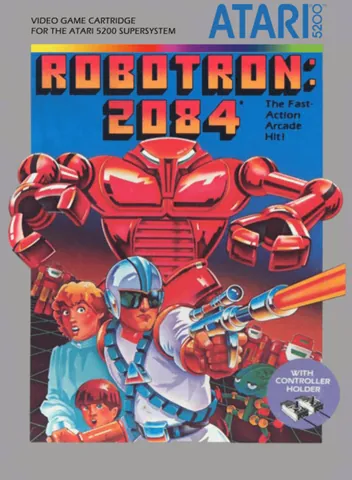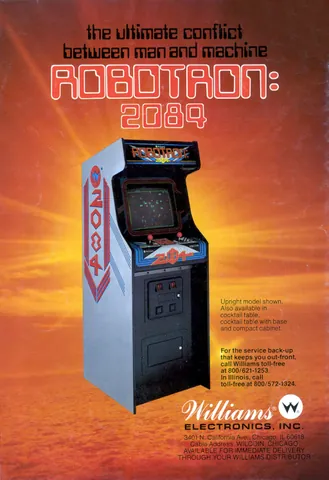
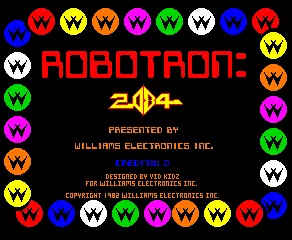
Two joysticks, no mercy. Robotron: 2084, which America's Williams Electronics unleashed into arcades in 1982, is pure distilled arcade chaos - a game so intense it won't let you catch your breath for a single second until you fall.
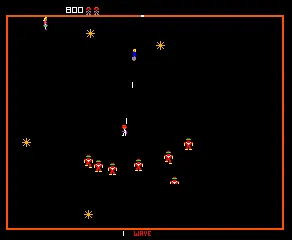
The most ingenious part is the control scheme itself. Instead of one joystick and a button, the player grips two sticks at once: the left moves the character, the right aims and fires independently of the direction of movement. This twin-joystick system was revolutionary and to this day defines the entire so-called twin-stick shooter genre. The player is dropped into a single screen flooded with hundreds of robots bent on their destruction, while trying to rescue the last surviving human family - mother, father, and child - by touching them before the enemies wipe them out.
What makes Robotron unforgettable is its merciless pace. Waves of enemies pour in from every side, and the different robot types behave differently - dim-witted Grunts surround you, Hulks are indestructible and must be avoided, Brains brainwash the humans you're trying to save. There's no time to think, only to react. It's a pure test of reflexes, spatial awareness, and the ability to keep a cool head amid total visual and nervous overload.
Behind the game stands the visionary designer Eugene Jarvis once again, this time working with Larry DeMar, both hardened by the success of Defender. They drew inspiration from dystopian sci-fi and from George Orwell's novel 1984, hence the year in the title. Robotron became both a critical and commercial triumph and is regularly ranked among the most influential video games in history.
The game's cultural legacy is immense. Twin-joystick controls came back to life in a generation of modern twin-stick shooters like Geometry Wars or Smash TV - the latter, incidentally, again created by Jarvis as a spiritual successor. Robotron has seen countless ports and re-releases, and in the competitive community it still holds a reputation as a game where true mastery is measured in waves survived. For many, it remains the pinnacle of pure, undiluted arcade action.
Why play: For the adrenaline of twin-stick madness in its purest form - a game that invented dual-joystick controls and still has no rival in intensity.
Game 34 of 258 for Arcade
The same title elsewhere (2)
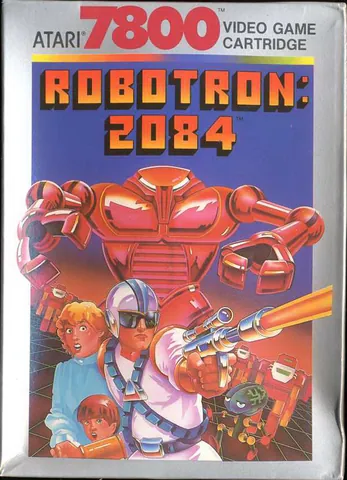
The arcade original was built around two separate joysticks — one for movement, one for firing in any direction independent of walking — which gave the game its uniquely fluid chaos. The Atari 7800 tried to replicate that by letting players plug two joysticks into both of the console's ports at once, an unusually faithful solution for a home conversion of its era. The 8-bit machine shows fewer enemies on screen at a time, and both graphics and sound are noticeably simpler than on the arcade board's dedicated hardware. For the pure adrenaline of twin-stick control, the arcade cabinet remains the reference, but the Atari 7800 version counts among the era's remarkably honest home ports.