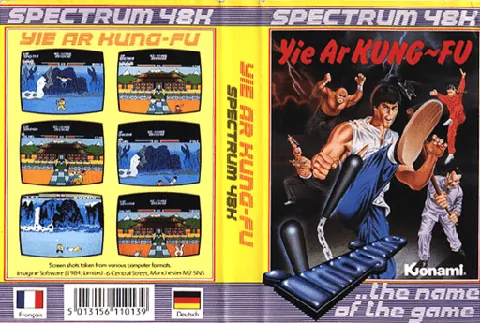
Yie Ar Kung-Fu
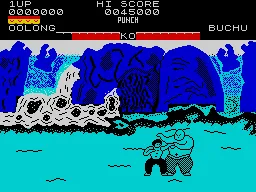

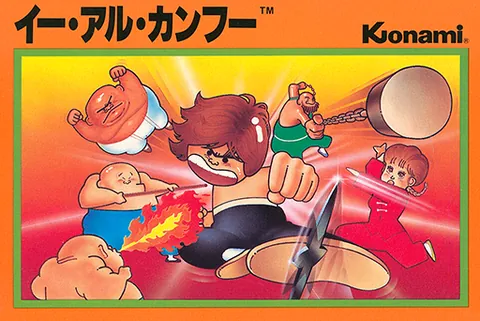
Yie Ar Kung-Fu brought to the ZX Spectrum a port of one of the first popular arcade fighting games, in which the fighter Oolong faces a series of opponents one after another, each mastering a different fighting style and wielding a different weapon — from nunchaku through a snake whip to fire breathing. The player has to discover each opponent's weaknesses and behavior patterns, since a straightforward attack often ran into an effective defense, making the fights more of a tactical puzzle than reflex-driven brawling. This emphasis on reading an opponent's patterns anticipated the later fighting-game genre built around the personalities of individual fighters.
On the Spectrum, the game managed to keep the fights readable despite the limited color palette, with clearly distinguished silhouettes of Oolong and his opponents against a simple dojo background. The controls offered a wide range of punches, kicks and jumps that could be combined with directional keys, giving the player a surprisingly varied repertoire on an eight-bit platform. The sound was sparse but functional, with distinct hit effects that gave the player clear feedback on how a fight was going.
Yie Ar Kung-Fu was praised on release for its innovative approach to the combat system and is among the titles that laid the foundations of the later fighting-game genre on home computers and consoles alike. Its concept of a gallery of opponents each with a unique style influenced many later fighting games. For today's player it mainly offers a historical glimpse into the early stage of the genre, whose mechanics feel archaic now but were remarkably sophisticated for their time at release. The Konami arcade original from 1985 was among the very first games to introduce a health bar for both fighters as the main indicator of a fight's progress — a principle that later became a standard across virtually the entire fighting-game genre. The gallery of opponents was arranged so the player would gradually face increasingly demanding and unpredictable behavior patterns, letting the game smoothly ramp up its difficulty without needing to change the basic rules of combat.
Why play it: For those interested in the history of fighting games, the gallery of opponents with unique styles and the pioneering health bar are worth seeing, even though the mechanics feel archaic today.
Game 59 of 100 for ZX Spectrum