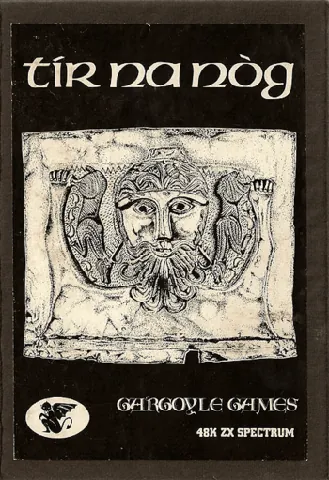
Tir Na Nog
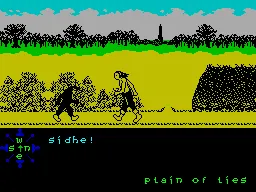
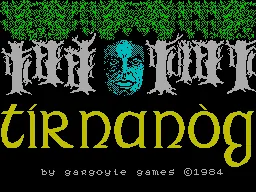
Tir Na Nog was released in 1984 by Gargoyle Games and ranks among the pioneering isometric action-adventures that foreshadowed later hits on the Spectrum such as Knight Lore. The player controls the druid Cuchulainn, who finds himself in the Celtic underworld after death and must find five parts of his body in order to come back to life and return to the world of the living, while dangerous spirits and mythical creatures pursue him along the way. The game's world draws on Irish and Celtic mythology, a refreshing motif in the then Anglocentric production of fantasy games that gave the game a distinctly different visual and thematic identity.
Gameplay is built on exploring dozens of interconnected screens rendered in isometric perspective, solving puzzles, collecting and combining items, and avoiding dangerous creatures that can kill the player and send them back to the start. Unlike the later Filmation engine that made Ultimate Play the Game famous, Tir Na Nog used its own technical solution, which was somewhat slower but still offered smooth platform jumping and a convincing sense of three-dimensional space. The graphical style, with finely drawn characters and sparse, mysterious music, evoked the melancholic atmosphere of the underworld.
The game was very well received in the year of its release and represented a major success for Gargoyle Games, which the studio followed up with the sequel Dun Darach and later Marsport, both of which developed the same game system and mythological theme further. Tir Na Nog's influence on the isometric adventure genre was notable, and it ranks among the titles that helped define this hugely popular Spectrum subgenre alongside the output of Ultimate Play the Game. Today it is appreciated mainly as a historically significant step on the way to later, more elaborate isometric series, although the slower animation and terse controls demand a fair amount of patience from the player.
Why play it: For fans of isometric adventures, Tir Na Nog is a historically significant step that, alongside the titles of Ultimate Play the Game, helped define the entire subgenre, even though the slower animation requires patience.
Game 64 of 100 for ZX Spectrum