Laser Squad
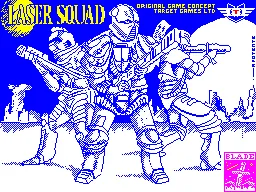
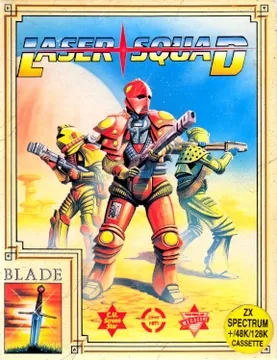
Laser Squad is a turn-based tactical game by Julian Gollop, released in 1988 by Target Games and distributed by Blade Software. The player commands a small squad of soldiers or alien units and, on a clear isometric map, decides on every step, shot, and turn of a character using an action-point system. There are several mission types — from rescuing hostages through defending a base to a firefight between two teams — and the game also offered a two-player battle against each other, then a fairly unusual feature on the Spectrum, which could also be played on a single computer by taking turns.
It was precisely the elaborate action-point system, which allowed combining movement, aiming, ranged shooting, and reaction fire, that gave Laser Squad a hallmark of depth that action games on eight-bit computers of the time usually didn't offer. Weapons differed in range, penetration, and action-point cost, so choosing equipment before a mission was just as important as conducting the fight itself. The graphics were clean and functional by Spectrum standards, and gunfire and explosion sounds underscored the tension of every turn, where a single mistake could cost an entire unit. The game was played slowly and deliberately, which set it apart from most action titles of the time and brought it closer to tabletop war games.
Contemporary critics received the game very positively, and Laser Squad became one of the most acclaimed strategy titles on the Spectrum, not least thanks to the included mission editor, which let users design their own scenarios. Its significance, however, extends beyond the game itself — a few years later, Gollop built X-COM: UFO Defense on its foundations, which made the action-point and tactical command system famous worldwide. Laser Squad is still played today as an elegant demonstration of how a well-thought-out tactical game can be built on limited hardware, and fans of the genre rightly consider it a mandatory entry in the history of turn-based strategy games.
Why play it: For fans of turn-based strategy games seeking an elegant demonstration of the foundations on which Gollop later built X-COM: UFO Defense, complete with a mission editor for custom scenarios.
Game 73 of 100 for ZX Spectrum