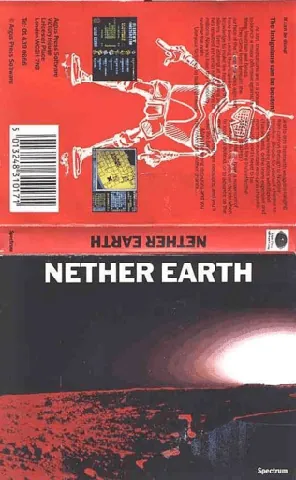
Nether Earth
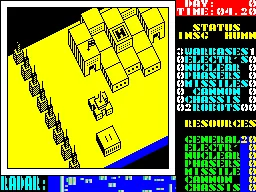
Nether Earth is a 1987 strategy game created by Really Software that ranks among the early forerunners of the real-time strategy genre. The player controls a warring faction on a planet dotted with robot factories: there they assemble their own combat robots from several components — chassis, weaponry, and other modules — and then send them to fight the opponent's machines and capture their bases. The goal is to destroy all enemy factories before the opposing player does, and both production and robot movement must be managed continuously while the game clock keeps running regardless of whether the player is currently issuing orders.
For its time, this was a remarkably open concept: combining base building, unit production, and direct real-time command of robots was technically demanding on the eight-bit Spectrum, and the game handled it surprisingly well, albeit with a limited number of simultaneously active units. The choice of robot components genuinely affected combat behaviour — faster, lightly armed machines suited reconnaissance, while more cumbersome variants worked better for defending factories. The graphics consisted of a simple top-down map, functional enough for the player to keep track of factory layout and robot movement. The game could also be played by two people, which wasn't a given at the time.
Nether Earth received recognition in contemporary reviews for its originality and strategic depth, though it remained more of a cult title in the shadow of more popular action games. From today's perspective it's interesting mainly historically — it shows that the ideas behind later RTS games like Dune II or Command & Conquer had forerunners on eight-bit computers, which coped with hardware limitations in their own way, several years before a similar approach became standard in the genre. For fans of the early history of strategy games, it's a title worth trying, though its pace and controls demand patience today.
Why play it: For fans of the early history of strategy games who'll appreciate a forerunner to later RTS titles like Dune II or Command & Conquer, even though its pace and controls demand patience today.
Game 75 of 100 for ZX Spectrum