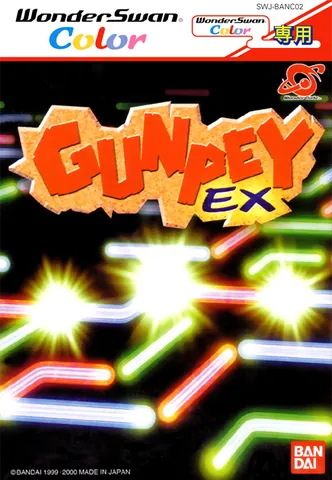
Gunpey
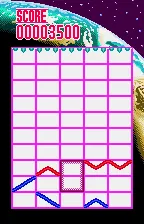

Gunpey is among the first games Bandai released on its new handheld console, and even its name pays tribute to Gunpei Yokoi, the engineer behind the concept of portable gaming as well as the technical foundation of the WonderSwan. The principle is rarely this pure: the playing field is divided into vertical columns holding short line segments, both horizontal and diagonal. The player shifts the segments up and down, trying to assemble a continuous line connecting the left edge of the field to the right. Once a line closes, it disappears and scores points. The longer and more winding the connection you manage to create, the bigger the reward. Meanwhile new rows of segments keep appearing from below and push the screen's contents upward, so the player is always working under constant pressure.
Such a simple rule grew into a game with surprisingly large room for strategy. A skilled player doesn't place segments where the line closes fastest, but builds several unfinished paths side by side and then connects them into a chain with a single move. The controls fit the WonderSwan like a glove, since the console offers two sets of directional buttons and can be held both vertically and horizontally. Moving a segment is a matter of a single thumb flick, and the game never forces the player to shift grip. The monochrome display isn't a drawback — everything rests on shapes and contrast, not color. The music is economical, loop-based, and subtly speeds up its tempo as the field fills.
At the time, Gunpey worked exactly as Bandai intended. It was a title you could pull out for a few minutes on the subway, and just as easily spend a whole evening with, while also serving as a showcase for what the new console could do. The brand later received sequels and versions on other platforms too, which is a solid track record for a late-1990s handheld puzzle game. Today Gunpey still feels fresh mainly because it doesn't try to be anything other than a perfectly tuned mechanism. It has no story, no unnecessary modes, and its charm lies in how quickly the brain learns to read a jumble of small lines as a future path.
Game 15 of 27 for Bandai WonderSwan