Magic Carpet
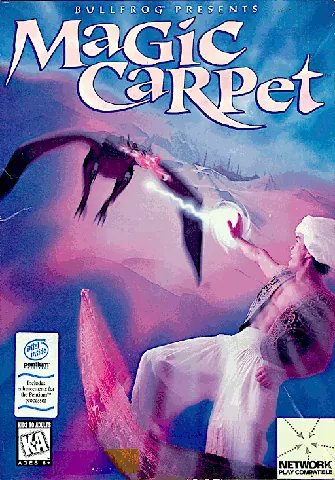
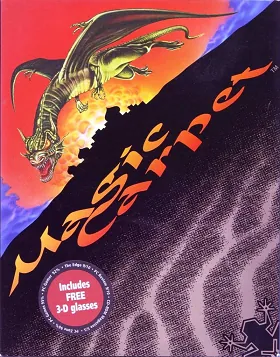
Magic Carpet was one of the most visually ambitious games of the mid-1990s thanks to its fully textured, smoothly undulating terrain, over which the player flies on a magic carpet and casts offensive and defensive spells against enemy sorcerers and their creatures. Besides combat, the player also has to build mana from sacred sites and expand their territory, which gives the game a strategy-genre dimension too, and it was precisely this aerial movement in every direction combined with open spatial freedom that made the game a natural candidate for the Forte VFX1, since the feeling of flying over a landscape was exactly the kind of experience stereoscopic headsets promised to deliver better than a monitor.
Reality turned out to be more complicated, however, because the game's smooth, technically demanding terrain engine combined with the headset's low resolution produced an image where landscape details were blurry and orientation over large maps was difficult, which also made basic territory management and spotting enemy towers at a distance harder. The combination of free flight along all three axes and a limited field of view also caused significant nausea in many players, since the brain had few visual reference points for judging speed and altitude, and the head-tracking latency only made the effect worse, so only the most tolerant players tended to stick with the headset.
Even without VR support, Magic Carpet earned a reputation as one of the technically most advanced games of its time and inspired later titles built on destructible terrain and ranged magical combat, including its own sequel, Magic Carpet 2. In the context of the VFX1, it remains proof that not every type of movement suited early headsets equally well, and that open flight, despite its appeal, was one of the most demanding scenarios for the stereoscopic technology of the time and its limited refresh rate.
Why play: Fans of destructible terrain and ranged magical combat will enjoy the technically advanced Magic Carpet, even though open flight was one of the most demanding scenarios for VR headsets of that era.
Game 5 of 12 for Forte VFX1