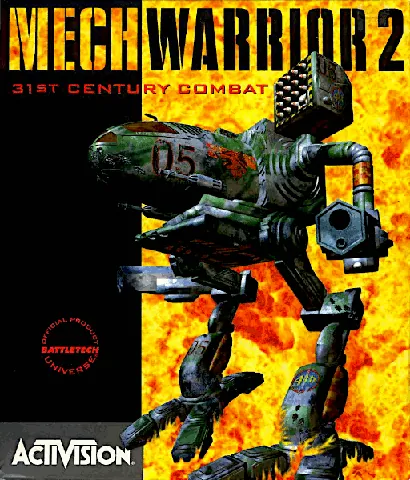
MechWarrior 2: 31st Century Combat
MechWarrior 2: 31st Century Combat put the player in the cockpit of a giant combat robot, a BattleMech, and offered a simulation full of heat management, ammunition, and damage to individual parts of the machine in battles against the Wolf and Jade Falcon clans in the world of the BattleTech universe. The cockpit perspective, full of instruments, and the need to rotate the mech's torso independently of the head's view so the player could aim weapons in a direction other than where their machine was moving, made it one of the most natural candidates for Forte VFX1 support, since tracking the radar, targets, and instrument panel with head movement made sense in the context of a cockpit simulator.
In the headset, however, a typical problem of that generation of VR showed up, namely that the more information the game needed to display at once, the worse the VFX1's low panel resolution handled it. The small readouts on temperature, ammunition, and damage to individual mech parts, to which the game gave much greater emphasis than classic shooters, were hard to read in the headset's stereoscopic display, and the mechs' slower, lumbering movement fortunately counted among the less demanding scenarios for motion sickness, so MechWarrior 2 was, compared to fast shooters, more tolerable, though not without difficulty when rotating the torso quickly to track an enemy.
MechWarrior 2 is regarded today as one of the most significant mech simulators of all time, with a dense atmosphere heightened by its metallic cockpit design and unmistakable orchestral score, and it became the foundation for an entire series of sequels and expansions, including standalone add-ons focused on individual warring clans. Its emphasis on tactics, choosing loadouts before a mission, and the gradual damaging of specific mech parts gave the game an unusually simulation-like character for its time. In the history of the VFX1, it belongs among the titles where the headset managed to at least partly fulfill its promise thanks to the slower pace of play, even though the readability of its small instruments remained a lasting weakness.
Why play: Fans of tactical mech simulators will enjoy MechWarrior 2 for its dense atmosphere and emphasis on loadouts and mech damage, and thanks to the game's slower pace, it's among the titles where the VFX1 headset worked relatively best.
Game 9 of 12 for Forte VFX1