Sid Meier's Railroad Tycoon
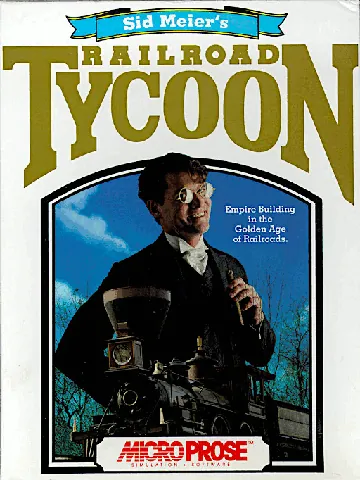
Sid Meier's Railroad Tycoon cast the player as a nineteenth-century railroad magnate and in doing so founded an entire branch of building games still called "tycoons" today. You start with borrowed capital, an empty map, and a single decision: where to build your first station. Track is laid tile by tile across hills, rivers, and forests, every stretch costs money, and every steep grade slows the train down. Stations have different reach, and only once a town, mine, or farm falls within their radius does cargo start accumulating there that's actually worth hauling somewhere.
Out of this grows a surprisingly rich economic game. Raw materials only turn into goods at the appropriate industries, so coal and iron gain value only at the steel mill and cattle only at the slaughterhouse, and the player hunts for profitable town pairs worth connecting with a line. Add to that train scheduling, choosing locomotives that grow stronger and faster over time, building sidings and signals so trains don't block each other, and finally the stock market. Shares of your own company and of competitors can be bought, borrowed against, and, with a bit of nerve, used to take a rival over completely. Every map also runs in real time, which can be sped up or paused, so play switches between calm planning and tense watching to see whether a train will arrive on time.
On DOS, it was a very readable game: a map with clean, colorful graphics, smooth controls, and understated sound effects, where the strongest impression comes from a locomotive's whistle and the announcement that a line has been completed. At the time, the title was praised for how easily it drew players in and how deep it let them fall, and its legacy lives on in later installments and a whole host of imitators, including transport simulators. Today it still delights mainly because it emphasizes clever network planning over quick reflexes, and a single game can easily swallow a whole evening. It helps that the player can choose both the map and the historical period, and try out how differently railroads get built in mountainous Europe versus on the open American plains.
Game 62 of 204 for PC / DOS (XT až 486)