Survival Kids
Long before the wave of survival games flooded Steam and players spent their nights gathering wood to make it to morning, a single pocket hero was shipwrecked on a deserted island — and had to fend for himself. Konami's Survival Kids from 1999 was a title that was ahead of its time by whole years.
The premise is simple and all the stronger for it: you wake up alone on a desolate island, and your only task is to survive. No score, no levels in the classic sense — just hunger, thirst, the scorching sun, and your own decisions. You must search for food, combine found items into more useful tools, and gradually cope with the inhospitable environment. Crafting, resource management, and the constant pressure of basic needs — that is, exactly the mechanics that define the whole genre today — were present here as early as the late '90s, and moreover crammed into a Game Boy cartridge.
What makes the game especially remarkable is its emphasis on decision-making. Your choices affect how the story turns out, and the game offers multiple endings depending on how you make your way through the island and how you behave. That makes it an unexpectedly personal experience — it's not just about enduring, but about which path you choose and what you're willing to sacrifice. For its time and its platform it was a remarkably thought-out system.
The series later continued under the name Lost in Blue, confirming that the idea had solid foundations. Survival Kids thus feels today like a fascinating forerunner — a concept that was perhaps too unconventional in its day to build a mass audience, but that carried within it the DNA of what, more than a decade later, became one of the most popular game genres of all.
It is a title that rewards curious players and collectors of gaming history alike. To play Survival Kids today is to glimpse the moment when one direction of game design was being born — and when a bold studio bet on hunger, thirst, and human decisions instead of gunfire and score.
Why play: A visionary survival game with crafting and a branching story that was ahead of the entire genre by years — and that fits in your pocket to boot.
Game 36 of 147 for Nintendo Game Boy
The same title elsewhere (1)
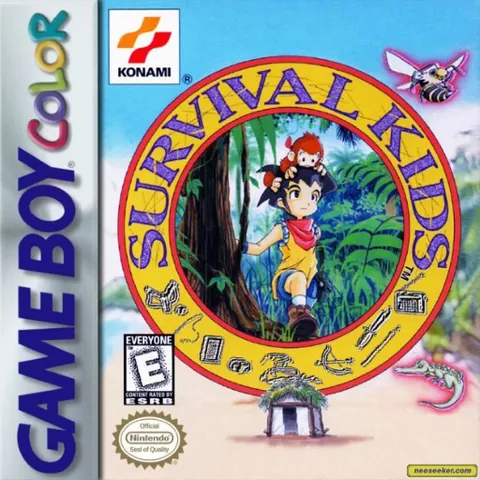
Both versions came out the same year, 1999, and offer essentially the same survival game on a deserted island — the main difference lies in the graphics. The classic Game Boy version runs only in shades of gray, while the Game Boy Color release adds color, making it easier to spot plants, materials and hazards around you at a glance. The gameplay mechanics, island size and difficulty stay the same, so it's more of a cosmetic than a content difference. Anyone who prefers a clearer picture should reach for the color GBC version, while players chasing the authentic 1999 experience can happily stick with the original Game Boy.