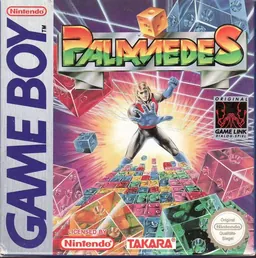
Palamedes
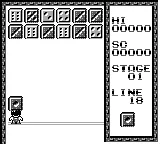
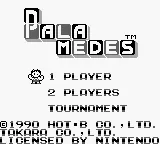
Palamedes is a puzzle game from Hudson Soft that came to the Game Boy in 1990 as a port of an originally arcade and home-console title. The player manages pairs of falling dice marked with pips like a regular die, and the goal is to line them up so that the sum or match of values on adjacent dice forms a combination that gets cleared from the playing field. As the levels progress, both the falling speed and the complexity of the required combinations increase, making the game a typical representative of the rapidly rising difficulty genre common in the wake of Tetris's success. The game is spiced up further by a competitive mode against a computer-controlled opponent, where successfully formed combinations send troublesome rows to the opponent's side, adding an element of direct confrontation to what is otherwise purely logical gameplay.
On the Game Boy the game uses simple but clear graphics, where the values on the dice remain easy to read even on the monochrome display, which is key for quick decision-making. The controls are limited to basic shifting and rotating of the falling pairs, so players learn the rules within a few minutes, while truly mastering the higher levels requires practice and quick estimation. The musical accompaniment is a simple, repeating motif typical of the era's productions, underscoring the game's rising tempo.
Palamedes was among the early puzzle titles that, riding the wave of falling-block popularity, sought their own variation on the Tetris formula - in this case through dice instead of geometric shapes. On the Game Boy it found its place among fans of logic games, even though it never achieved wide recognition outside genre connoisseurs. Today it stands as an interesting reminder of just how varied the early attempts to follow up on Tetris's success were, and of how even a seemingly small change to the input piece - a die instead of a block - could create a distinctly different feel.
Game 131 of 147 for Nintendo Game Boy