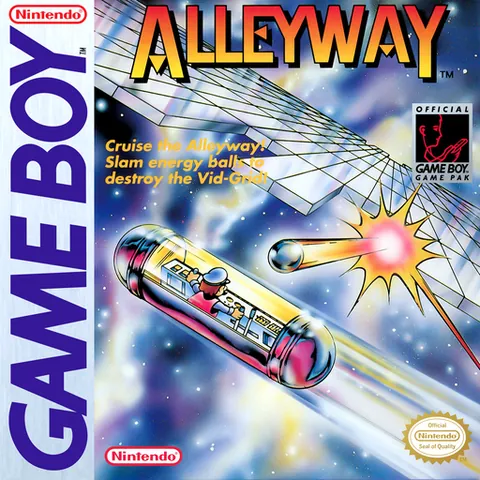
Alleyway
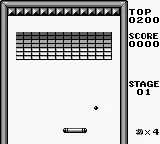
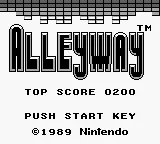
Alleyway was among the Game Boy's launch titles and is Nintendo's take on the classic concept of destroying a brick wall by bouncing a ball with a movable paddle, popularized by games like Breakout back in the arcade cabinet era. The player progresses through a series of levels with differently arranged rows of bricks, trying to destroy them all without losing all their balls, while the difficulty gradually rises with faster ball movement, added blocks, and more complex obstacle layouts. Some levels also contain special blocks that grant bonuses or change the ball's behavior when hit, adding a small strategic layer. The game is divided into several dozen progressively more demanding screens, making it suitable for both a short session and a longer, focused attempt at the best possible result.
Despite the simplicity of the concept, the game makes elegant use of the handheld's monochrome display — the contrasting brick blocks stay clearly legible even in fast motion, and the paddle response is precise, which is absolutely crucial for this type of game. The player can bounce the ball at different angles depending on where it strikes the paddle, giving the game an unexpected degree of control over the trajectory of bounces. The soundtrack is minimalist, with short melodic motifs that underscore the game's undemanding, relaxed atmosphere, well suited to short gaming sessions on the go.
At launch, it was one of the titles meant to demonstrate the new handheld's versatility beyond big platformers and RPGs, and as a simple arcade affair it served its purpose well. From a genre perspective, Alleyway is more of a historical curiosity than an innovation, being an honest, functional take on an already well-established concept. Today the game is remembered mainly as part of the Game Boy's launch lineup and as an example of how undemanding, accessible games worked well on the portable platform right from the handheld's very beginning.
Why play it: As part of the Game Boy's launch lineup, it's more of a historical curiosity than an innovation, but its honest execution of a well-established arcade puzzle concept still holds up today.
Game 68 of 147 for Nintendo Game Boy