Myst

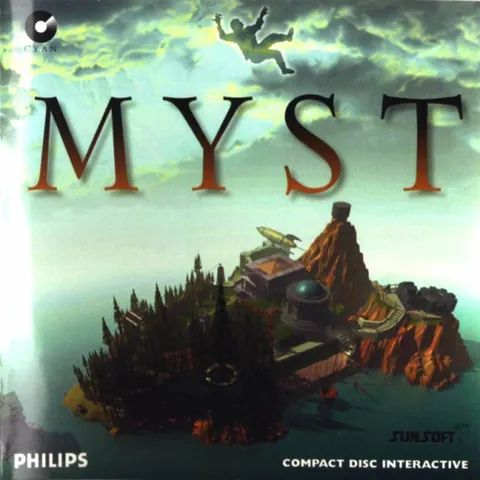
Myst appeared on the Philips CD-i quite late, when the platform was already fading, yet it remains one of the most valuable titles ever brought to it. The player finds themselves on an abandoned island with no instructions, no goal, and almost no text. All that is available is an environment full of machines, libraries, pipes, and control panels that must be understood and set in motion. Gradually, further worlds open up from books, each with its own logic and its own mechanisms, and fragments of journals piece together the story of two brothers and their father. There is no enemy here, no time limit, no way to die — only curiosity and honest observation.
The game is built on pre-rendered images between which the player moves by clicking, which on CD-i shows up as longer loading times and a slower-moving cursor than on a computer. Visually, though, the island still holds up today: the static scenes are carefully composed and enhanced with subtle animation and, above all, sound. The audio side is crucial, since the quiet music, wind, waves, and the hum of mechanisms carry the entire atmosphere of solitude. The puzzles are not bolted on from the outside but grow out of the world itself, so the player is not guessing what the author wants but discovering how the machine in front of them actually works.
Myst became one of the best-selling games of the nineties and for a long time defined what a calm adventure game for a wide audience looked like. Critics praised its ideas and its technical execution, with reservations aimed at the static nature of the world and occasional aimless wandering. Today its influence is visible wherever a game tells its story through environment and lets the player explore at their own pace. The CD-i version is interesting mainly as proof that this phenomenon found its way even onto a console hooked up to a television — a setting where, unlike at a computer monitor, people mostly played in twos or threes. And it is precisely in pairs, with one person sketching diagrams on paper and the other handling the cursor, that Myst works best.
Game 7 of 13 for Philips CD-i
The same title elsewhere (1)
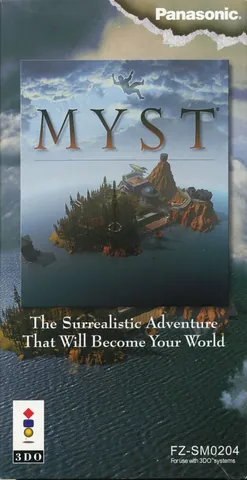
The 1994 3DO version was one of the titles the console liked to show off — it managed to carry over the pre-rendered backgrounds and video sequences at a quality close to the computer original, though players had to get used to longer loading pauses between screens dictated by the CD drive's speed. The Philips CD-i version didn't arrive until 1996, on hardware that was already aging and less powerful, and loading between locations is noticeably slower still, with slightly softer image quality. For a smoother, more visually faithful experience, the 3DO version is generally the one recommended today.