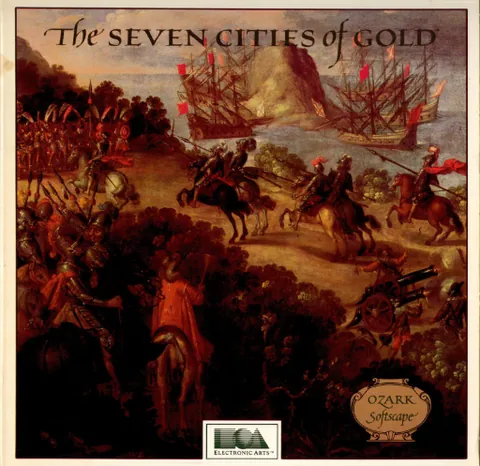
Seven Cities of Gold
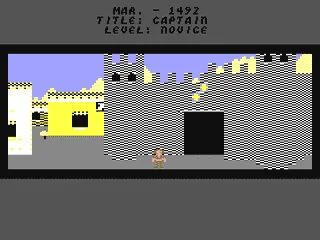
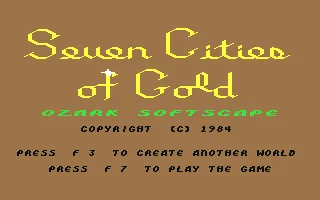
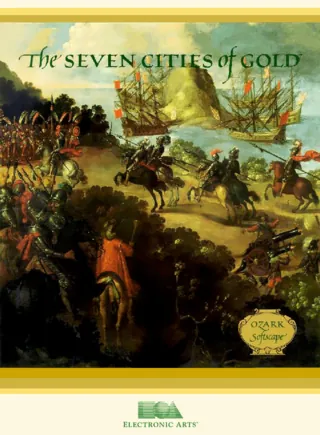
Seven Cities of Gold casts the player as a conquistador exploring and colonizing the New World during the age of exploration. The game combines a sea voyage across the Atlantic, exploration of an unknown continent, contact with native civilizations, and the building of settlements and trading posts—the player decides for themselves whether to trade with the native tribes and build peaceful relations, or to exploit and plunder their gold. How the player treats individual tribes also affects how easily they will later replenish supplies, find new allies, or learn the location of the legendary golden cities the game is named after.
On the Commodore 64, the game offers a procedurally generated continent map, so every expedition is different, and it weaves several distinct layers of gameplay—from sailing a ship to overland expeditions to settlement management—into one cohesive whole. The graphics are simple but functional, and the game prides itself on a sense of discovering unknown territory, where the player never knows in advance what they'll find beyond the next hill or river. Switching between views from the ship's deck, an overland expedition, and founding a settlement gives the game a pace that's unusually varied for an eight-bit computer.
The game was created by Ozark Softscape, centered around Danielle Bunten Berry, known for her emphasis on player freedom and an open decision-making system with moral consequences. Seven Cities of Gold is often ranked among the pioneering titles of the open-world strategy simulation genre and influenced later games about exploration and colonization, including the studio's own Pirates! series, which the authors followed up with a few years later. Even decades later, it's clear the game emphasized freedom of decision over linear progression, setting it apart from the more common strategy games of the time with fixed objectives. On the Commodore 64, the game also showed that even relatively modest hardware could carry a simulation with several interconnected systems at once, without falling apart into a series of isolated minigames.
Why play it: For lovers of open-ended strategy games that emphasize freedom of decision over linear progression, you'll also appreciate how modest hardware managed to carry several interconnected systems at once.
Game 89 of 121 for Commodore 64