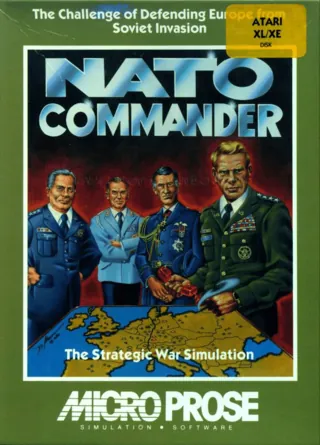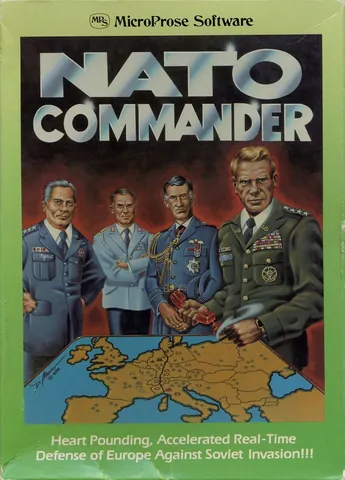
Nato Commander
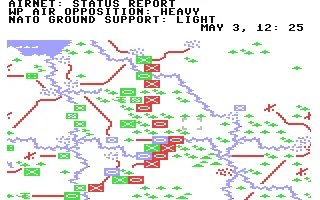
Nato Commander is one of Sid Meier's early games, in which the player commands NATO forces in a hypothetical conventional conflict in Central Europe against the forces of the Warsaw Pact. The game is built on a hexagonal map across which infantry, armor, and air force units move, and the player must weigh the balance of forces, terrain, and supply lines to defend key territories against an attacker's superior numbers. The game offers several scenarios with different force ratios, so the player can try both balanced battles and hopeless-looking defensive actions, where the main task is to delay the enemy's advance for as long as possible. At the same time, the player must decide when to deploy air power to support ground units and when to hold it back for the later, decisive phase of the battle.
On the Commodore 64, the game benefits from a clear hexagonal interface and a relatively fast pace to each turn, making it more accessible and quicker to grasp than some of the more complex wargames of the time. Both the opponent's AI and the game's pacing were designed so that a session wouldn't eat up an entire afternoon, which was rather the exception in the turn-based wargame genre. The spare, functional graphics clearly distinguish the various unit types and terrain, so even after several turns the player easily keeps track of the overall situation on the front. The sound is restrained, limited to short movement and firing effects, signaling that the game's focus is tactical decision-making rather than audiovisual spectacle.
Nato Commander was made at MicroProse during the period when Sid Meier was still establishing himself as a designer of war simulations, before he later became famous for his civilization and flight titles. Today the game is interesting mainly as evidence of the early phase of his career and as an illustration of how the turn-based wargame genre, in the early 1980s, was searching for a way to reach a wider home-computer audience, well before Meier became one of the best-known names in the games industry.
Why play: Worth attention mainly for its historical value as an early work by Sid Meier, before his civilization and flight hits, and especially for fans of the wargame genre's development.
Game 92 of 121 for Commodore 64